Infundibulicybe gibba
Taxonomy
Main synonym
Common names
Clitocibe embudado, inbutu, tassa de bruc.
Geographic references:
Interactive map with data from GBIF.




Morphological Features:
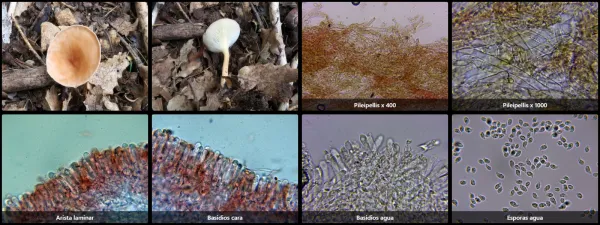
Pileus reaching up to 10 cm in diameter at most; initially flat with a conspicuous umbo, later becoming infundibuliform and markedly so, retaining the umbo although it becomes less prominent. Color ranges from ochraceous to cream, depending on specimen hydration. Margin festooned, incurved, thin, and slightly undulate.
Lamellae whitish in color, fairly crowded, and strongly decurrent on the stipe.
Stipe central and cylindrical, slender and occasionally elongated, similar in color to the pileus or somewhat paler. The base is typically covered with a whitish tomentum.
Flesh firmer in the center of the pileus, scant at the margin, tough within the pileus itself, and spongy in the stipe. It has a pleasant odor and a mild taste.
Habitat:
Most commonly found on fallen leaves of broadleaf trees, but it also fruits under conifers. It is a very common and abundant mushroom, particularly during the autumn months.
Observations:
Despite being non-toxic, the toughness of its flesh renders it unsuitable for collection and consumption. It closely resembles Paralepista flaccida, a conifer-associated species with a more tawny pileus; furthermore, it shares similarities with other clitocybes such as Clitocybe costata, which has a ribbed pileal margin, or Clitocybe catinus, characterized by a very pale pileus. These are but two examples, as further potential confusions exist.