
Imleria badia
Taxonomy
Main synonym
Common names
Boleto bayo, onddo arre, Sigró (bai).
Geographic references:
Interactive map with data from GBIF.



Morphological Features:
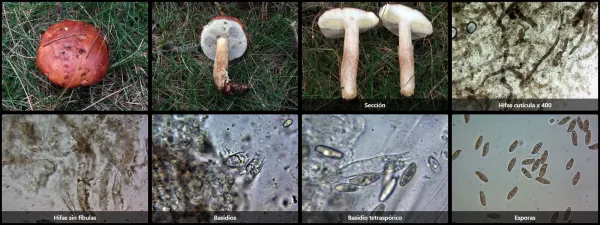
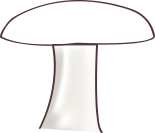
Pileus with a fleshy appearance and considerable size; fully developed specimens can reach 15 cm in diameter. Initially hemispherical, soon becoming convex, and finally somewhat flattened but never completely plane. Its color is dark within the brown, chestnut, or fawn spectrum. The surface is dry except during rain, under which circumstances it becomes notably viscid, an exceptional trait within Xerocomus. Margin generally excurrent.
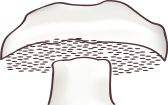
Tubes rather long, adnate to slightly decurrent, pale yellow when young, later turning green. They are separable from the pileal flesh and blue both upon handling and when cut.
Pores small and angular, very pale yellow initially, then becoming more vividly yellow, and finally greenish. They exhibit a marked bluing reaction upon the slightest touch.
Stipe cylindrical and elongated, brown in color due to longitudinal fibrils of the same hue covering a barely perceptible yellowish background. Generally robust and fibrous.
Flesh firm and thick, white when the specimen is young, becoming more spongy and yellowish with age. In the stipe, however, it is fibrous. It blues upon cutting, with a pleasant, fruity odor and a sweet, equally agreeable taste.
Habitat:
A very frequent and widespread species that fruits throughout autumn. It is adapted to various habitats and substrates, occurring abundantly under conifers, but also fruiting beneath deciduous trees.
Observations:
This mushroom is a good edible, particularly when young, and is already being regularly harvested in many regions. Nevertheless, it does not reach the culinary excellence of Boletus edulis and related species. This species has a natural look-alike known as Boletus vaccinus, currently delisted or synonymized with Boletus badiorufus, and some authors even consider them all to be varieties thereof. The differences relative to Imleria badia include a more velvety cuticle, the absence of bluing reactions, and a reddish stipe tone. Xerocomellus chrysenteron features a cuticle that cracks to reveal a reddish background, along with a similarly reddish stipe.