

Xerocomellus chrysenteron
Taxonomy
Main synonym
Common names
Boleto de carne amarilla, onddo urregorri, mataparent de carn groga.
Geographic references:
Interactive map with data from GBIF.




Morphological Features:
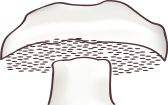
Pileus not excessively large for the genus; in maturity, some specimens may briefly exceed 10 cm in diameter. Its shape is hemispherical at emergence, subsequently developing a convex form, and finally becoming practically flattened. The surface is initially dark brown, with some specimens approaching black; at this stage it is velvety. Throughout its development, it acquires olive-brown tones, meaning it pales while simultaneously losing its initial pubescence. In maturity, and particularly under low humidity, the cuticle cracks and oxidizes to reddish tones in the fissures, but the surface itself is never red.
Tubes adnate and rather long, initially yellowish and subsequently becoming olive-colored.
Pores broad and angular, initially yellow and later dull greenish; they turn blue upon pressure, albeit faintly.
Stipe well-proportioned or elongated, cylindrical and rather narrow in mature specimens, solid, with a slight tendency to taper towards the base. It has a bright yellow background color but is almost always red-pustulate, a color that predominates to the naked eye; only the apex appears yellow, and not even in all specimens.
Flesh relatively thick but somewhat spongy in consistency, yellowish in color; it adopts reddish tones in the pileal fissures and beneath the cuticle, and turns blue upon cutting.
Habitat:
This is a very common and widespread species throughout the Spanish territory; it has been observed practically year-round, although it fruits most abundantly in autumn. Furthermore, it occurs in almost all types of forests, which increases the likelihood of encountering it, although it generally does not fruit in large groups or high densities.
Observations:
This bolete is characterized by the cracking of the cuticle, which reveals reddish tones; however, the cuticle itself is never red, and this feature only occurs in mature specimens, as the surface of young specimens is uncracked and much darker. Several related species exist, such as Hortiboletus rubellus, with a striking vermilion-red cuticle; Boletus ferrugineus, which lacks such a red stipe and does not crack to reveal reddish tones; or Boletus subtomentosus, which lacks red tones and features longitudinal ridges on the stipe. It is distinguished from Xerocomellus ripariellus by spore ornamentation, although we do not rule out that it may represent an ecological form of the same species.