
Hygrophorus roseodiscoideus
Taxonomy
Main synonym
Common names
Not available
Geographic references:
Interactive map with data from GBIF.
Morphological Features:
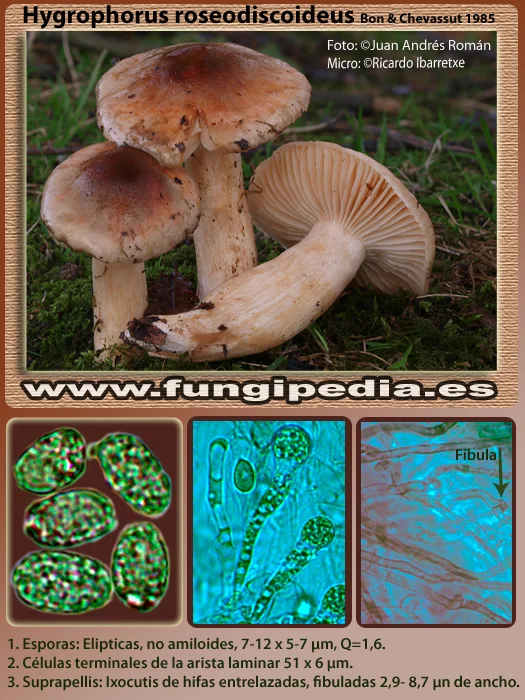
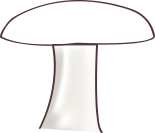
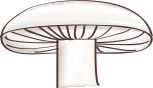
Pileus of considerable size for its group, typically exceeding 5 cm in diameter and frequently approaching 10 cm. Generally convex in shape, though it flattens with age to become somewhat depressed, while retaining a central umbo throughout its development. The surface is quite viscid when wet and even glossy in dry conditions, fibrillose, with a reddish-brown center darker than the rest, a broad pinkish zone, and a cream-colored margin. This margin remains incurved for an extended period.
Lamellae adnate in some specimens and decurrent in others; as is typical for the genus, they are rather widely spaced, cream-colored with pinkish or flesh-colored tinges.
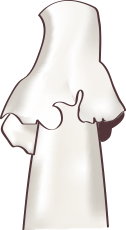
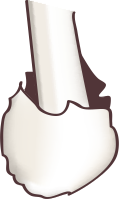
Stipe rather elongated, whitish with occasional pinkish or flesh-colored tinges as seen in the lamellae, clearly attenuating towards the base and sometimes becoming radicate. It is viscid, though less so than the pileus, and typically exhibits an annular zone due to a conspicuous partial veil, which tends to disappear over time.
Flesh dense in the pileus, white but pinkish beneath the cuticle; both its odor and taste are mild and agreeable.
Habitat:
This is an infrequent species with a late fruiting season; however, where it occurs, it typically fruits in groups rather than solitarily. Its preferred fruiting period is late autumn to early winter, predominantly in holm oak and oak woodlands.
Observations:
This is an edible species from which the cuticle should be removed; considered acceptable by some, but not a choice edible. It is characterized by its viscid and umbonate pileus, darker center, and late fruiting season. Hygrophorus discoideus is similar, with lighter tones, and its spores are notably smaller. Hygrophorus lindtneri is also easily confused with it, but prefers a habitat under hazels, although it also fruits under beeches, and is even more viscid if possible.

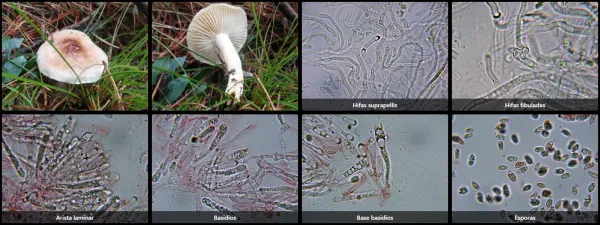
Microscopy of Hygrophorus roseodiscoideus