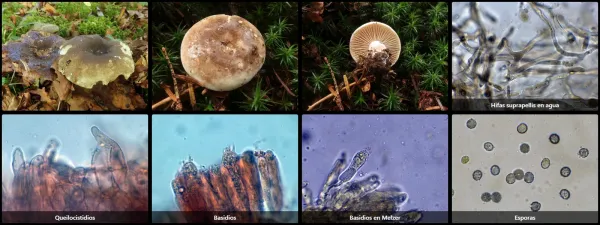

Russula adusta
Taxonomy
Main synonym
Common names
Rusula negruzca, cualbra carbonera, gibelilun orrizabala.
Geographic references:
Interactive map with data from GBIF.


Morphological Features:
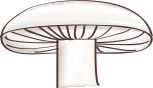
Pileus that readily exceeds 10 cm in diameter in mature specimens, with it not being uncommon to find specimens measuring 15 cm or more. Its shape is hemispherical initially but soon becomes convex to umbilicate, tending to become depressed or infundibuliform when old. Cuticle adnate, dry in appearance, with a color that varies considerably; initially whitish, it gradually darkens through ochre tones to brownish-black, becoming practically black in its final stages. The margin remains incurved for most of its development, only becoming extended in old specimens.
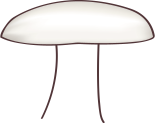
Lamellae adnate and widely spaced, thick, light-colored, almost white when young, but acquiring pinkish or ochre tones before ultimately blackening like the entire basidiocarp; upon handling, they first stain reddish and then black. Lamellar edge concolorous, turning black with age.
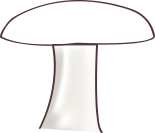
Stipe short and stout, solid when young and later hollow, cylindrical or slightly attenuate at the base, whitish in color, staining reddish upon handling and subsequently black.
Flesh thick and brittle, white in color; upon cutting, it initially turns reddish, gradually darkening to a brownish-black. Its odor is faint, slightly fruity, and its taste is sweet.
Habitat:
This is a very common and abundant species in many regions of Spain, forming groups of numerous specimens in both coniferous forests and under various broadleaf trees. It appears from summer through autumn; some specimens desiccate without decaying and remain with a carbonized appearance in the forest for months.
Observations:
This species can be distinguished from others within section Compactae by its widely spaced lamellae; it is characterized by the flesh initially turning red and subsequently black. It is also noteworthy that the flesh often does not decay, and the fruitbodies remain in the forest resembling black fungal fossils. Despite being sweet, it lacks notable culinary value, although some authors classify it as edible. Russula densifolia has more crowded lamellae, is also common, and its flesh exhibits the same color change as the species described here. Russula acrifolia is similarly prone to confusion, possessing acrid-tasting lamellae, as are other blackening Russula species.