
Hygrophorus marzuolus
Taxonomy
Main synonym
Common names
Seta de Marzo, Martxoko Ezko.
Geographic references:
Interactive map with data from GBIF.


Morphological Features:
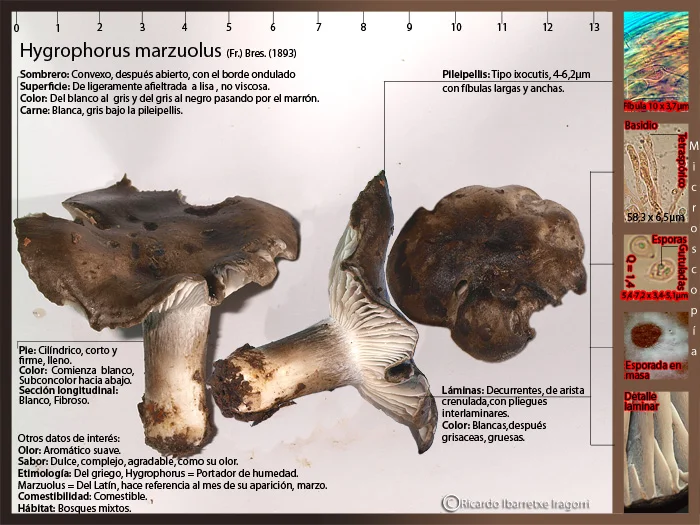
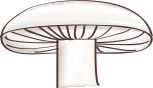
Pileus that can exceed 10 cm in diameter, hemispherical to convex, finally expanded with an incurved and undulate margin. Initially nearly white, but quickly turning to grey and brownish tones with blue-grey hues, featuring a smooth and poorly viscid cuticle.
Lamellae initially somewhat crowded but soon becoming widely spaced, very white when young, turning greyish with age, slightly decurrent.
Stipe short, thick, and cylindrical, white in color, but gradually turning grey with age starting from the base.
Flesh white and tender, of good thickness in both the pileus and stipe, with a faint odor and a mild, sweet taste.
Habitat:
Fruits primarily in mixed forests, although also found in pure pine stands, with a preference for siliceous soils. Its fruiting period occurs in winter and early spring, which is somewhat unusual in mycology.
Observations:
Choice edible; given its fruiting period it can be considered the first edible mushroom of the year, hence highly sought after but difficult to find due to its scarcity. In autumn, several species appear that may bear some resemblance, such as Hygrophorus camarophyllus, with a brownish-grey pileus and a longer stipe, and Hygrophorus atramentosus, somewhat more silvery but notably similar. Due to its coloration, it could be confused with Russula nigricans, which reddens before turning black and lacks a greyish stipe.

Microscopy of Hygrophorus marzuolus