Hydnangium aurantiacum
Taxonomy
Main synonym
Common names
Falsa trufa anaranjada
Geographic references:
Interactive map with data from GBIF.




Morphological Features:
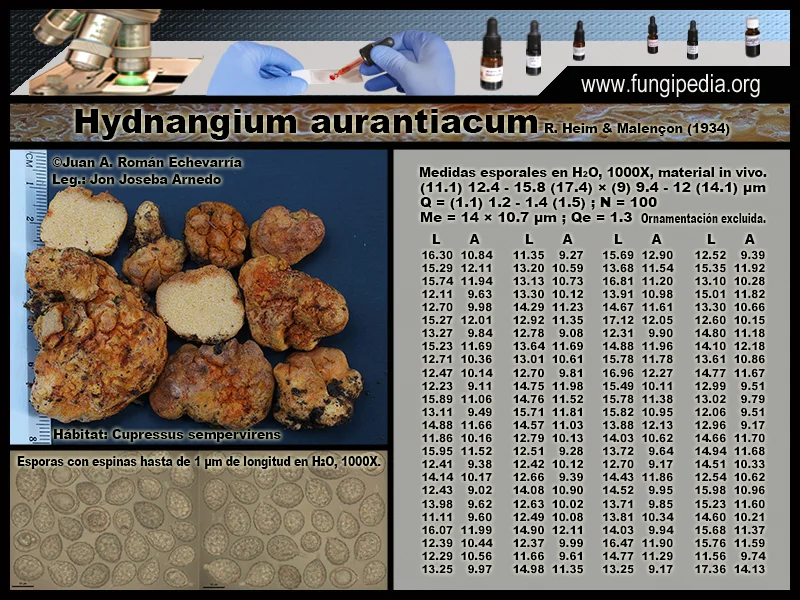
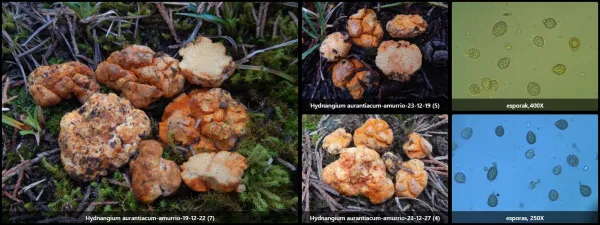
Basidiocarp of medium to even notably large size for the genus in question, typically with a diameter in mature specimens ranging between 1 and 3 cm, though it is possible to find some larger specimens exceeding 5 cm. It exhibits the typical tuberous form characteristic of hypogeous species, which is quite irregular, bearing random protrusions or fissures, and even some rugosity. The overall appearance is that of a dry and slightly rough fruiting body, lacking significant gloss, and featuring a matte yellowish or orange color with darker areas, making it quite striking. The presence of mycelial cords at the base is common; the base is usually fissured but does not form a cavity.
Peridium notably thin or delicate, to the extent that it often disintegrates with relative ease, partially revealing the gleba. It has a more or less conspicuous yellowish or orange color, and a dry, slightly felt-like appearance, with some darker spots in handled areas.
Gleba generally quite compact, composed of tightly packed chambers with a labyrinthine appearance, which tend to open slightly at maturity, accompanied by irregular sterile veins; both the chambers and veins are yellowish, sometimes orange, though in our collection they were pale yellow.
Flesh absent beyond the gleba itself, with a quite spongy texture, possessing a mild, rather insignificant taste, and a mild but characteristic odor, not unpleasant, which becomes somewhat more pronounced as the specimens mature.
Habitat:
We are undoubtedly dealing with a species that should be classified as semi-hypogeous, as it emerges underground but tends to break through the surface as it matures. Most species of the genus Hydnangium are typically associated with eucalyptus, but this is not the case for the species in question, which is much more widespread and can appear in quite diverse habitats. The specimens studied here were located by Joseba Arnedo in the town of Amurrio (Álava), fruiting under cypresses, Cupressus sempervirens. It is an infrequent and rather localized species, but where it fruits, it typically does so in more or less numerous groups; finding isolated specimens is rare.
Observations:
This species holds no culinary value, characterized by its yellow or more typically orange coloration, with a similarly yellowish or orange gleba, and a semi-hypogeous, cosmopolitan distribution. Based on these characteristics, the species it most closely resembles is perhaps Stephanospora caroticolor, especially considering that this species was also formerly placed in the genus Hydnangium, and that Hydnangium aurantiacum itself was once referred to as Hydnangium caroticolor and Stephanospora aurantiaca, thereby creating nomenclatural confusion. The microscopic differences between both species are evident; a mere examination of the spores suffices, as they exhibit a crown-like ornamentation in Stephanospora and irregular erect spines in the species under discussion.
Microscopy of Hydnangium aurantiacum