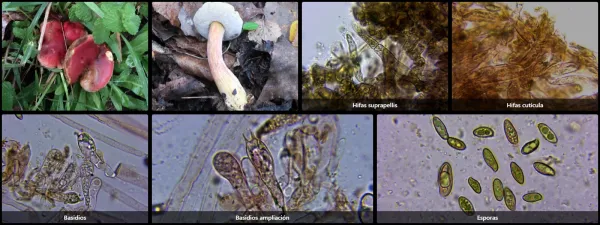
Hortiboletus rubellus
Taxonomy
Main synonym
Common names
Boleto multicolor, onddo gorri.
Geographic references:
Interactive map with data from GBIF.




Morphological Features:
Pileus of medium size, may exceed 5 cm in diameter but rarely reaches 10 cm; hemispherical when young, later becoming convex, and eventually nearly plane. Intensely bright red when young, fading to shades between pink and dull red. The surface is not separable from the flesh of the pileus, and is additionally dry, velvety, or tomentose. Requires severe drought conditions to crack.
Tubes adnate, yellow in color, becoming dingy with age. Turns blue noticeably upon bruising.
Pores angular, not too large, yellow turning olive-green with age. Also turn blue when pressed with a finger.
Stipe central and cylindrical, yellow in color; in most cases covered with a very fine red, and even pink, punctation, usually fading towards the base, but this is not a rule. Solid throughout.
Flesh Reddish beneath the cuticle, pale yellow elsewhere. Although not very thick, it is compact; odor fruity, taste mild and consistent with the odor.
Habitat:
Appears from spring through late autumn. We regularly observe it under American oak and other broadleaf trees, although it also occurs under conifers. According to the literature, it is not very common, though we encounter it annually without difficulty.
Observations:
We do not consider it culinarily valuable; although it can be consumed safely when well-cooked, it lacks high quality. It is commonly confused with Xerocomellus chrysenteron, which has a cracking cuticle from a young age, is less showy, and reddens at injuries. It is much more difficult to distinguish from Rheubarbariboletus armeniacus or Xerocomellus ripariellus, which have different habitats, or from Aureoboletus gentilis, whose flesh does not turn blue.