
Hebeloma mesophaeum
Taxonomy
Main synonym
Common names
Not available
Geographic references:
Interactive map with data from GBIF.





Morphological Features:
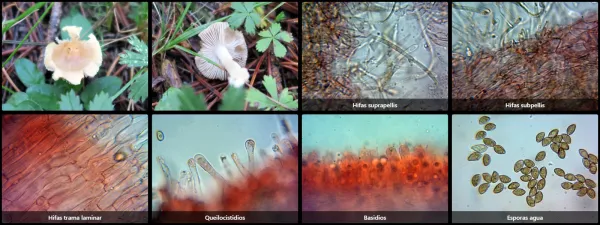
Pileus rather small for the genus, sometimes barely reaching 2 to 3 cm in diameter, and at most up to 6 cm. Bell-shaped in its early stage, subsequently convex, and later flattening considerably, often retaining a raised center. The surface is viscid in wet weather, glossy even when dry, displaying two sharply contrasting colors: an intense reddish-brown center and a pale ochre margin. Veil remnants on the margin disappear very rapidly, so it is usually found without them.
Lamellae adnexed to sinuate, pale when young, light ochre, darkening with age to brown. They are fairly crowded and sinuous, interspersed with lamellulae, and the edges frequently remain paler than the rest of the surface.
Stipe well-proportioned or elongated, pale in color, darkening from the base upwards; it also darkens superficially upon handling. It is fistulose and frequently bears conspicuous remnants of a partial veil, though scattered and insufficient to form a distinct annular zone.
Flesh rather thin, whitish in the pileus and brown in the stipe. It has a radish-like odor and an unpleasant, slightly bitter taste.
Habitat:
This is a very frequent and abundant species with gregarious growth habits, often forming rows or "fairy rings". It shows no preference for a specific tree type, occurring equally under conifers and various broadleaf trees. It is an eminently autumnal species that may occasionally appear in spring.
Observations:
This mushroom is characterized by the marked differentiation between the two colors of the pileus. Several related species exist; among them, we highlight Hebeloma cylindrosporum, which is typical of sandy pine forests, featuring a pruinose stipe lacking partial veil remnants and highly verrucose cylindrical spores. No species within the genus Hebeloma holds culinary value, as numerous toxic species causing gastric disturbances are present. This aspect remains poorly studied in many of them; therefore, all Hebeloma species should be rejected from a culinary standpoint.