
Gyrodon lividus
Taxonomy
Main synonym
Common names
Boleto livido, haltza-onddo, bolet livid.
Geographic references:
Interactive map with data from GBIF.
Morphological Features:
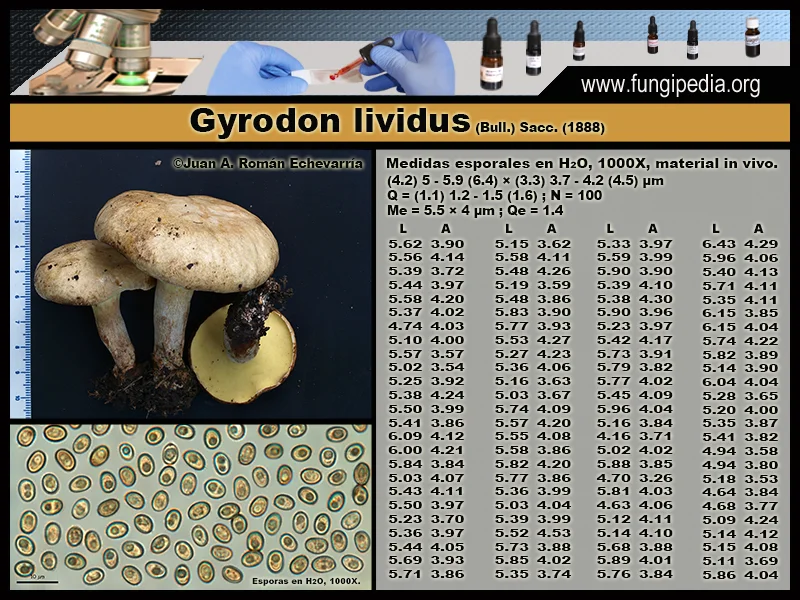
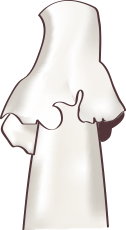
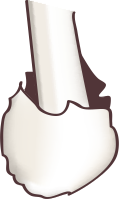
Pileus ranging from 5 to 12 cm in diameter, initially subglobose, then plano-convex and finally flattened, retaining an involute margin when young. Its primary color is ochre, though it turns brown upon handling or pressure. The surface is covered, especially when young, with woolly fibrils giving it a dry, felt-like appearance; however, it becomes viscid when mature and exposed to rain. Cuticle separable from the flesh.
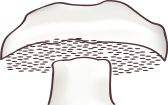
Tubes extremely short and strongly decurrent, bright yellow when young, turning olivaceous with age, and very dark in old specimens. They blue markedly upon the slightest contact. A characteristic feature is that they do not maintain a uniform cross-section along their entire length; they taper.
Pores extremely small, to the point of being barely visible to the naked eye when young, matching the color of the tubes, and similarly blueing upon pressure.
Stipe rather short, solid and hard, ochre-brown in color and covered with fibrils matching the pileus color, central or occasionally slightly eccentric. It is commonly found curved, and the base gradually develops a vinous-brown hue.
Flesh yellowish and thick in the pileus, blueing weakly when cut; firm when young, later becoming spongy. In the stipe it is hard and more fibrous, turning reddish or pinkish upon cutting after a short while, except at the base where it is vinous-brown.
Habitat:
This species forms mycorrhizae exclusively with alders and appears preferentially during autumn. It can be considered a rare species worthy of protection.
Observations:
Although edible, we do not recommend its consumption due to its rarity and mediocre culinary quality. It is a perfectly distinguishable species with no risk of confusion, owing to its exclusive habitat under alders, its very short yellow decurrent tubes, and its barely visible pores. Superficially it might resemble Paxillus involutus, but that species bears lamellae. Confusion with some Suillus species is less likely, as they all possess larger pores and less decurrent tubes.

Microscopy of Gyrodon lividus