
Paxillus involutus
Taxonomy
Main synonym
Common names
Paxilo enrollado.
Geographic references:
Interactive map with data from GBIF.


Morphological Features:
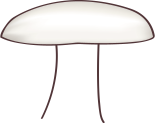
Pileus up to 15 cm in diameter, convex when young with an incurved margin, tending to flatten with age. The margin is typically striate and the color is dull brown, darkening in handled areas.
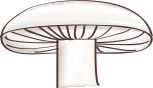
Lamellae ochre in color, darkening with age and staining an unattractive brown when touched. They are decurrent on the stipe and easily separable from the pileus.
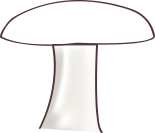
Stipe rather short, central, similar in color to the pileus or slightly paler; it also stains upon handling, particularly at the base, where it may take on a somewhat reddish hue.
Flesh fairly compact when young, becoming somewhat softer over time. Note: pleasant flavor and a non-offensive fungal odor.
Habitat:
A widely distributed species that appears year-round under favorable conditions, occurring in both coniferous and deciduous forests.
Observations:
This species is classified as DEADLY POISONOUS despite being listed as edible in older field guides. It has caused poisonings with fatal consequences. It may be confused with Tapinella atrotomentosa, which has a laterally attached stipe and grows on wood, and with Paxillus rubicundulus, which features an eccentric stipe, a more yellowish coloration, and is exclusively found under alders.