Entoloma clypeatum
Taxonomy
Main synonym
Common names
Rodofilo en forma de escudo.
Geographic references:
Interactive map with data from GBIF.





Morphological Features:
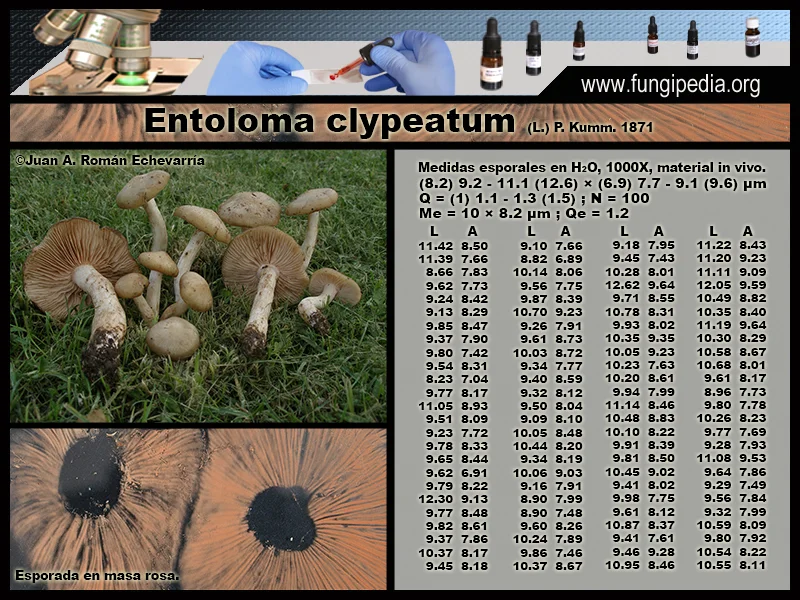
Pileus up to 10 cm in diameter, dark brown in color, sometimes slightly lighter with olivaceous or greyish tints. Its shape is flattened and possesses a characteristic central umbo that gives it a shield-like form, with a flexuous or undulate margin; it is also hygrophanous.
Lamellae adnate and crowded, cream or whitish-grey in color, turning pink due to the spore color. Rounded just before reaching the stipe, with a markedly irregular margin.
Stipe initially whitish but tending to grey, and it may even stain yellow when handled; quite robust, slightly curved, and fibrous. Occasionally found with bases attached to other specimens, although we consider it should not be regarded as caespitose.
Flesh whitish and tender, with a good taste when raw and a pleasant, not overly strong, farinaceous odor.
Habitat:
A predominantly spring species, typically associated with plants of the Rosaceae family, such as wild roses, white hawthorns, or blackthorns.
Observations:
This species is a choice edible, to be collected exclusively by experts, as its potential confusion with other Entoloma species makes it dangerous. It closely resembles Entoloma rhodopolium, an autumnal species, although this is always relative; it also resembles the spring species Entoloma aprile, whose most distinguishing characteristic lies in the lamellae, which possess a regular margin and are not rounded. Entoloma sinuatum is an autumnal species that lacks a shield-like shape and occurs in a different habitat.

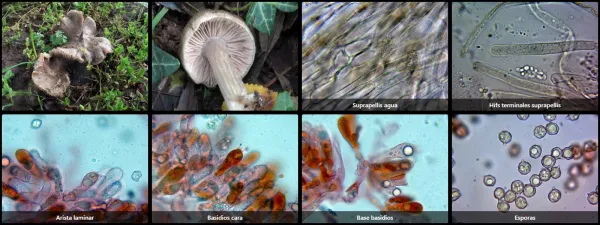
Microscopy of Entoloma clypeatum