
Encoelia furfuracea
Taxonomy
Main synonym
Common names
Copita de los avellanos
Geographic references:
Interactive map with data from GBIF.
Morphological Features:
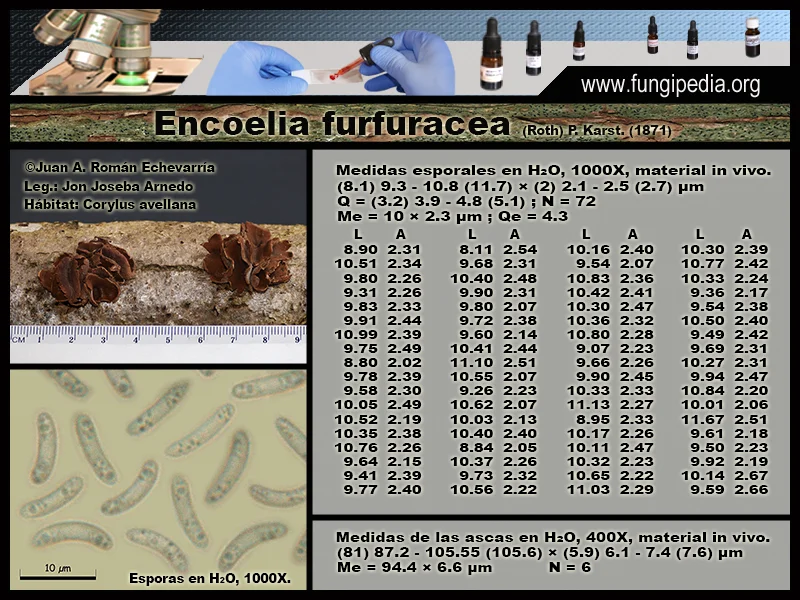
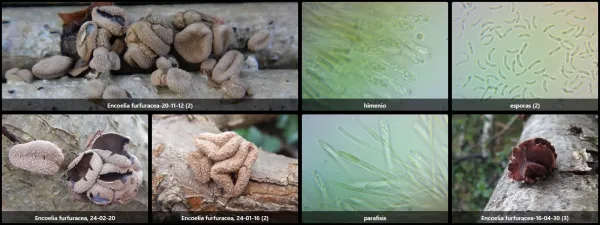
Carpophore emerging from the substrate with an elongated, closed cup-like shape; in early developmental stages it is completely closed and almost globose, progressively opening to become quite flattened under optimal humidity conditions. It is small in size, typically measuring between 5 and 15 mm in diameter, although several specimens often cluster together to form larger structures. The external part or exciple has a grayish color and a strongly furfuraceous or even scaly appearance, as it is composed of a series of globose hyphae emerging perpendicularly from the surface. Upon opening, the margin typically becomes highly crenulate, and sometimes even serrate.
Hymenium smooth, lining the internal portion of the apothecium, completely distinct from the external or excipular part, lacking any scaly features; its color is also markedly different, resembling a dark leather brown. It develops eight-spored, inamyloid, club-shaped asci, septate paraphyses, and allantoid spores, all of which can be observed in our microscopy section.
Stipe absent as such; although some authors consider the presence of a rudimentary stipe, we interpret the narrowing at the base merely as the attachment of the fungus to the substrate, and therefore it is a sessile species lacking a true stipe.
Flesh practically absent; its small size and lack of flesh make it unsuitable for culinary consideration, with a practically negligible odor and taste.
Habitat:
Although there are some records of the species on other trees such as alder, the preferred habitat of this species is undoubtedly hazel branches (Corylus avellana), where it emerges by breaking through the bark of dead branches, sometimes recently fallen and at other times while still attached to the tree. It typically fruits solitarily or in clustered groups, and is not a heavily documented species; however, we believe it is more common than it appears, merely fruiting during winter and early spring—a season less conducive to foraging—and possessing a somewhat exclusive habitat. The specimens featured in this study were collected by our collaborator Jon Joseba Arnedo.
Observations:
Due to its frequent occurrence on branches still attached to the tree, it was once considered a parasitic species; however, this is not the case. It is saprobic, contributing to the decomposition of dead branches. For these Encoelia species, it is crucial to first identify the host substrate on which it fruits to narrow down identification. Encoelia fimbriata is a very similar species, but it is specific to willow wood (Salix spp.) and has shorter, broader spores; Sclerencoelia fascicularis fruits on poplar or ash and possesses larger spores. In summary, if an Encoelia is found on hazel during winter, it can be confidently identified as this species.
Microscopy of Encoelia furfuracea