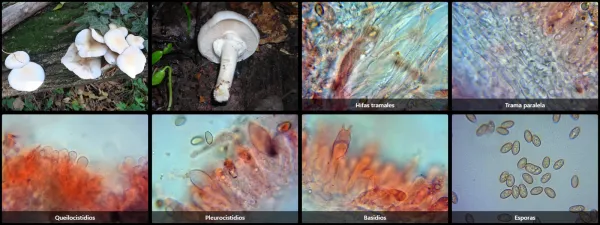

Cyclocybe cylindracea
Taxonomy
Main synonym
Common names
Seta de chopo, makal ziza, pollancró.
Geographic references:
Interactive map with data from GBIF.





Morphological Features:
Pileus 4 to 10 cm in diameter, occasionally slightly larger, hemispherical at inception, becoming convex, and eventually tending to flatten out, though not completely. Initially typically chocolate brown, sometimes cream-colored, fading to distinctly creamy tones as it ages. The margin usually remains incurved for a considerable period.
Lamellae initially cream-white, later becoming ochre, adnate and somewhat crowded.
Stipe generally curved, long and slender, attenuated at the base, pale in color. Bears a white membranous ring near the apex that turns ochre as the fruit body ages; it may become adherent but is usually persistent.
Flesh whitish, compact and firm in the pileus, highly fibrous in the stipe, with a pleasant taste and odor.
Habitat:
This species may fruit at any time of year, provided climatic conditions are favorable. Fruiting in fascicles on stumps or living trees, including poplars, willows, and elms.
Observations:
The photographed specimens were growing on a diseased willow in an urban area. Examination of its reproductive behavior indicates it produces 9 to 10 flushes annually; last year, fruiting only ceased in January, July, and August. It resembles Agrocybe praecox, a spring species that is gregarious and terrestrial. This is an edible species.