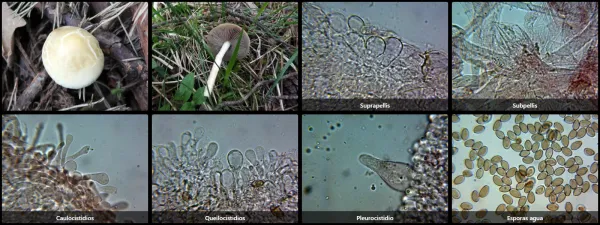
Agrocybe praecox
Taxonomy
Main synonym
Common names
Agrocibe precoz, landaburu goiztiar.
Geographic references:
Interactive map with data from GBIF.




Morphological Features:
Pileus 3 to 8 cm in diameter, hemispherical at first, becoming convex, and finally flattened. Its color is cream when young, evolving to ochre tones with age. It is slightly hygrophanous, yet it lacks striations on the margin. Usually smooth, cracking very little under dry conditions, and the margin bears remnants of the veil when young, which later disappear.
Lamellae distinctly sinuate, cream-colored at first, soon turning brownish with violet tints. They are quite thick and even broad.
Stipe central, cylindrical, and generally curved, longer than the pileus diameter, sometimes slightly bulbous at the base. Initially pale in color, but turning ochre with age. It bears a ring in the upper portion that is fragile, remaining attached to the stipe over time, although it is a conspicuous ring that rarely disappears completely.
Flesh tender and delicate in the pileus, white in color; in the stipe it is fibrous and ochre. Odor farinaceous to grassy, and taste also farinaceous and slightly bitter.
Habitat:
We consider it an eminently spring species; we have always found it during that season. It fruits in grassy places, meadows, gardens, or forest edges. A localized species, abundant in some areas and absent in others.
Observations:
It is a terrestrial species, a feature that distinguishes it from Agrocybe cylindracea. It also bears some resemblance to Agrocybe dura, a paler species that cracks easily and lacks a farinaceous odor. It is a mushroom not worth consuming due to its poor taste, despite being non-toxic.