
Coprinus comatus
Taxonomy
Main synonym
Common names
Barbuda, matacandil, urbeltz, bolet de tinta, chipirón de monte.
Geographic references:
Interactive map with data from GBIF.
Morphological Features:
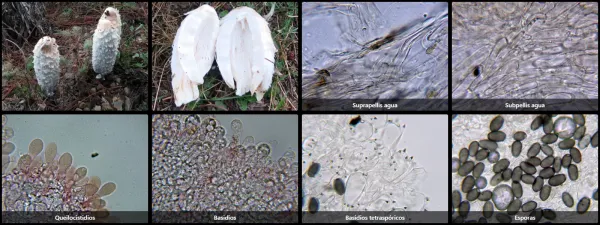
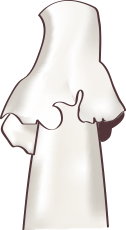
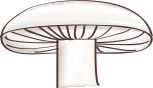
Pileus distinctly ovoid in shape when young, later campanulate, white in color. It is covered with woolly scales of the same color or slightly brownish, except at the apex, where it bears an ocre-colored patch that often resembles a glued-on leaf. Its size ranges from 5 to 15 cm in height by 3 to 4 cm in width, and the margin is lacerate.
Lamellae very white when young, later pink, finally black and deliquescent, free from the stipe and quite crowded.
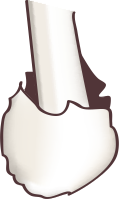
Stipe cylindrical and elongated, white and fibrous, terminating in a small bulb. Snaps cleanly when separated from the pileus, which occurs with great ease; soon becomes hollow and bears a small, fugacious white ring.
Flesh white, rather thin and fragile, somewhat firmer and fibrous in the stipe; as the basidiocarp matures, it turns pink and eventually black, exuding an ink-like fluid of that color. It has a mild fungal odor and a pleasant taste.
Habitat:
Fruits primarily during autumn, along road verges, rubble heaps, nitrogen-rich sites, and in areas where the soil has been recently disturbed. Experience indicates that the mycelial beds of this species persist for only a few years.
Observations:
It is a choice edible, with a pleasant taste and delicate texture, provided that only entirely white specimens are collected. It may be confused with Coprinopsis atramentaria, which is toxic, has a smooth pileus, and lacks the woolly scales characteristic of the species described here. Some authors treat Coprinus ovatus as a distinct species, although it may represent a variety.