Clavariadelphus pistillaris
Taxonomy
Main synonym
Common names
Porra, mano de mortero, joiki arrunt, bossa.
Geographic references:
Interactive map with data from GBIF.




Morphological Features:
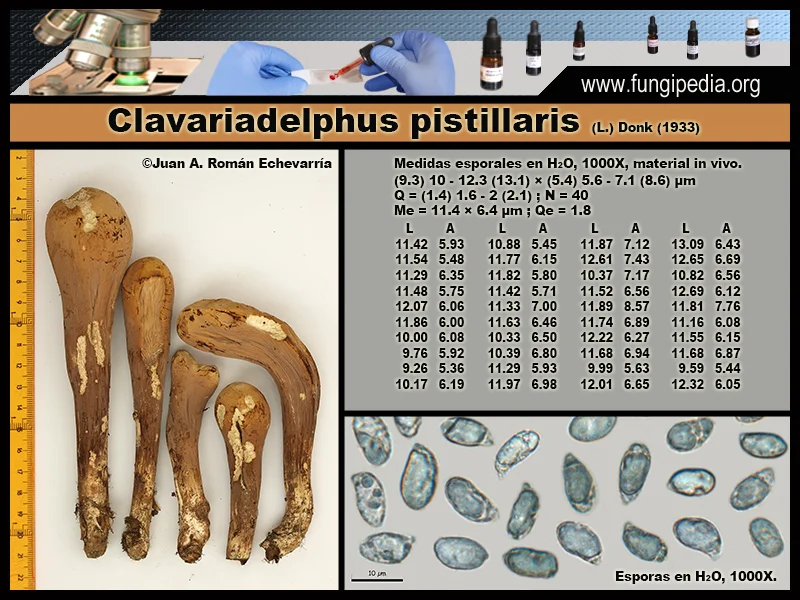
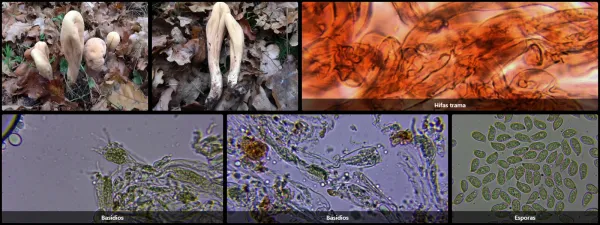
Basidiocarp invariably exhibiting a curious club-shaped or mortar-pestle-like form, reaching up to 20 cm in height, with an upper width that can exceed 5 cm. Initially pale and yellowish, it quickly acquires its characteristic orange-ochre hue for which it is known, displaying areas of varying color intensity. The apical region is typically smooth and slightly or not at all truncated, whereas the gradual tapering towards the base almost invariably presents wrinkles or irregularities, occasionally appearing grooved.
Hymenium immersed within the surface of the basidiocarp, with only the basal region remaining sterile.
Stipe not distinguishable from the remainder of the basidiocarp; consequently, the basal tapering cannot be regarded as a true stipe.
Flesh firm in young specimens, later becoming somewhat spongy and soft, white in color. Upon cutting, it turns various shades, ranging from ochre or vinous to occasionally lilac. The odor is mild and indistinct, while the raw taste is distinctly bitter.
Habitat:
This species fruits in broadleaf forests, with a particular preference for beech woods, often appearing gregariously. Its fruiting period is autumn, making it difficult to encounter in other seasons. Historically frequent and even abundant, it is now observed less frequently each season, suggesting a possible population decline.
Observations:
Its peculiar club or truncheon shape and its orange-ochre to somewhat tawny coloration render it virtually unmistakable. It is inedible due to the bitterness of its flesh, which diminishes upon boiling and discarding the water; nevertheless, we do not consider it worthwhile to collect for culinary purposes. A species that may bear some resemblance is Clavariadelphus truncatus, characterized by a distinctly truncated apex and a very abrupt widening, with notably sweet flesh. Clavariadelphus ligula is a miniature counterpart of Clavariadelphus pistillaris, occurring under conifers.
Microscopy of Clavariadelphus pistillaris