
Clathrus ruber
Taxonomy
Main synonym
Common names
Clatro rojo, kaiola gorri, gita de bruixa.
Geographic references:
Interactive map with data from GBIF.


Morphological Features:
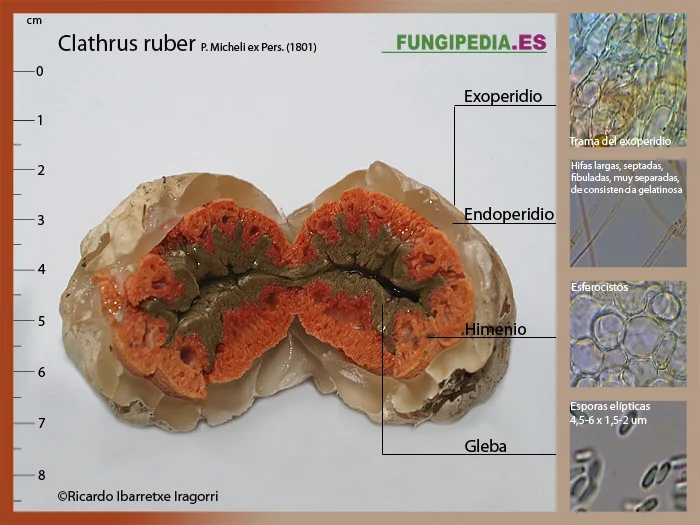
Peridium initially presenting as an egg with a soft, gelatinous consistency, white in color and sometimes spotted with ochre. At the base, it possesses a thread-like stalk attaching it to the mycelium, while at the apex, grooves radiate towards the base in various directions without being parallel. As the egg matures, these grooves split open to reveal the carpophore.
Carpophore generally ovoid in shape, sometimes even spherical, sessile and therefore lacking a stipe. It resembles a lattice-like framework with wide openings, or a hollow sphere internally, typically exceeding 5 cm in height. Its color is strikingly vivid red. The remnants of the original egg remain attached at the base, resembling a volva.
Gleba coating the inner surfaces of the aforementioned framework, olive-green in color, emitting a strong fetid odor that attracts insects and facilitates spore dispersal.
Flesh practically nonexistent. In the egg stage, both its odor and taste are radish-like; however, once opened, they become unbearable and fetid.
Habitat:
It has been observed in gardens, under oaks, and even on grassy slopes adjacent to pine forests. It shows a preference for the autumn season but also fruits in spring, and occasionally in summer. It is not very common.
Observations:
This species has few potential look-alikes, except in the egg stage when it may resemble Clathrus archeri or Phallus impudicus; however, a cross-section will clearly distinguish it. Colus hirudinosus is smaller and possesses a more distinctly defined gleba.
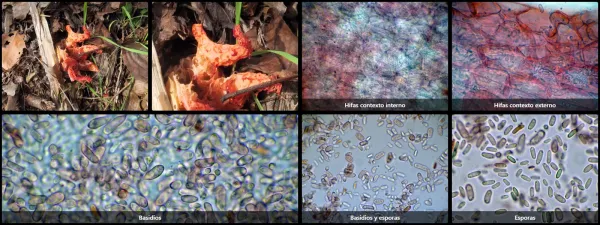
Microscopy of Clathrus ruber