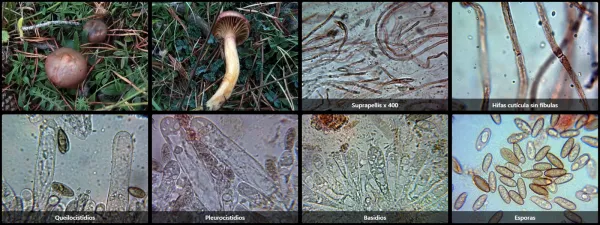

Chroogomphus rutilus
Taxonomy
Main synonym
Common names
Pata de perdiz, seta reluciente, pinu-ziza arrunt, cama de perdiu.
Geographic references:
Interactive map with data from GBIF.
Morphological Features:
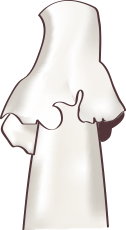
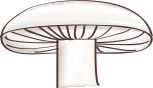
Pileus in adult specimens can reach a diameter of up to 10 cm, though it is more commonly found between 5 and 8 cm. When young, it is conical or bell-shaped, provided with an umbo that is more or less acute at this stage, and attached to the stipe by an evident filamentous veil. With maturity, it becomes more expanded, often retaining the umbo which is now less pronounced, and in isolated specimens may be barely umbonate. The color ranges from ochre with reddish tints to browner or coppery tones, and the surface is markedly viscid, especially after rain, without becoming glutinous. The margin remains incurved during the early stages of the specimen, expanding later.
Lamellae strongly decurrent, widely spaced, and notably thick, with a somewhat waxy appearance; yellowish when young, gradually darkening to dark brown and even blackish in age. They are characterized by being easily separable from the pileal flesh; in younger specimens, they appear arched.
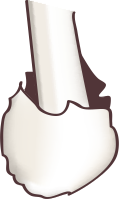
Stipe generally longer than the pileal diameter, often curved, cylindrical, or more typically attenuated at the base. It is ochraceous, slightly paler than the pileus, sometimes with cinnamon tints, and is additionally fibrillose and viscid, the latter especially after rain. The upper portion bears a cortinate annular zone, evident in young specimens, which usually disappears with age.
Flesh thick and compact, firm, pale yellowish except at the stipe base, where it is a more vivid saffron-yellow than in the rest of the basidiocarp. It has a slight tendency to darken to somewhat reddish tones where handled; its odor is nearly absent and its taste is sweet.
Habitat:
A mycorrhizal species associated with pines, under which it typically appears in small groups. It is an eminently autumnal species that may occasionally appear at other times of the year, and is quite frequent and abundant in certain areas.
Observations:
An edible species of modest culinary value belonging to the gilled boletes, characterized by its easily separable and strongly decurrent lamellae, an umbonate pileus, and a viscid appearance throughout the basidiocarp. Several congeners may be confused with it; notably Chroogomphus fulmineus, which has brighter colors and is less viscid, and Chroogomphus helveticus, which has a dry, pilose pileus when young, lacks an umbo, and is uniformly orange-ochre. Gomphidius glutinosus may also resemble it somewhat, but its cuticle is covered by a gelatinous layer and its stipe is yellow from the annular zone to the base.