
Chlorophyllum rachodes
Taxonomy
Main synonym
Common names
Apagador menor, parasol de carne roja, galanperna mamigorriska, apagallums de cama blanca.
Geographic references:
Interactive map with data from GBIF.


Morphological Features:
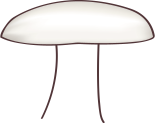
Pileus of intermediate size among Macrolepiota species, its diameter can reach up to 20 cm at most. Initially globose, it gradually opens to become hemispherical, then convex, and finally expands flatly. Its surface is covered with brown scales, which may have a reddish or grayish tinge, and crack more or less concentrically toward the margin, leaving a brownish disc in the center. The background is whitish, sometimes with pinkish spots, and the margin is almost always fringed and cracked.
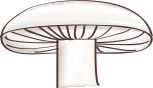
Lamellae free from the stipe, white with a tendency to redden in damaged areas; when old, they turn brownish, especially on the lamellar margins.
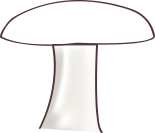
Stipe cylindrical with a noticeable basal swelling, pale in background but with fibrils imparting an ochraceous or grayish tone. It is fistulose and reddens when scratched with a fingernail; it also bears a double, movable ring, generally whitish.
Flesh thick in the pileus, white that initially turns reddish upon cutting, then becomes dingy after a few minutes. The stipe is woody and lacks the fleshy consistency of the pileus. The taste is sweet, and the odor is fungoid.
Habitat:
This fungus is variable even in its habitat; it may fruit in forests, along road edges, and in meadows. It is relatively common to find Chlorophyllum brunneum, formerly considered the variety hortensis of Chlorophyllum rhachodes, in areas near human settlements, such as rubbish tips. It is a frequent autumnal species but not overly abundant in many regions.
Observations:
Macrolepiota venenata was formerly considered an independent and toxic species, but is now synonymized with Chlorophyllum rachodes. However, a similar toxic species does exist: Chlorophyllum molybdites, which has a greenish spore print. It appears that the variety hortensis itself, now Chlorophyllum brunneum, is indigestible for sensitive stomachs, perhaps partly due to its occurrence in ruderal areas, which entails significant heavy metal uptake. More typical and larger is Macrolepiota procera, with a tiger-striped stipe and white spore print; it is a choice edible.
