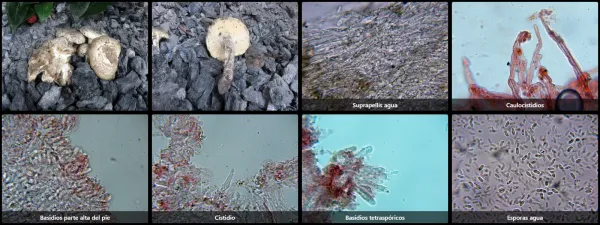

Cerioporus corylinus
Taxonomy
Main synonym
Common names
Seta de borto, seta de quemada.
Geographic references:
Interactive map with data from GBIF.


Morphological Features:
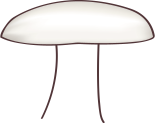
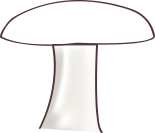
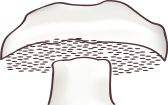
Pileus variable in size and color; some adult specimens barely reach 3 to 4 cm in diameter, while others may double this measurement. During the initial stage of development, they exhibit a very pale, whitish or cream color, but gradually turn ochre. The shape is fairly regular, initially convex but soon flattened and finally depressed at the center. Older specimens typically have a cracked surface forming irregularly distributed scales, whereas young ones are smooth. The margin is very thin and incurved.
Hymenium composed of very short tubes, no more than 4 mm long, white in color and clearly decurrent, along with polygonal pores of the same color that are very small in young and immature specimens, but expand considerably upon spore maturity.
Stipe proportionate in size to the pileus, whitish with a tendency to turn ochre as occurs with the pileus, completely smooth and glabrous. Its position relative to the pileus is highly variable, with centrally attached specimens predominating, but it can also be found eccentric and occasionally lateral.
Flesh thin and somewhat elastic in consistency, white in color. In younger specimens, this flesh is tender, but in older ones it becomes much firmer, even corky; a similar progression occurs with the taste, which is mild and sweet initially but becomes slightly bitter in older individuals. The odor is pleasant in all cases.
Habitat:
Fruiting on the roots of various shrub or tree species that have been subjected to fire; the current name of the species alludes to Corylus sp, but we are familiar with it and have collected it on the burned roots of Arbustus unedo, commonly known as madroño or borto. It appears in rather numerous groups, never isolated, although as individual specimens not clustered together. It emerges after rains on burned ground; we have observed it in autumn, but it may appear at other times of the year. A rare and highly localized species.
Observations:
Young specimens of this species constitute a fairly good edible; however, older ones are nearly inedible. When observed in its natural habitat, this species is unmistakable as the only Cerioporus that fruits profusely on burned ground, although other species within the genus share morphological similarities. The most similar species is likely Cerioporus rhizophilus, which emerges on grass roots, but it is not a pyrophilous species.