
Picipes rhizophilus
Taxonomy
Main synonym
Common names
Poliporo de las gramíneas, poliporo de las raíces.
Geographic references:
Interactive map with data from GBIF.

Morphological Features:
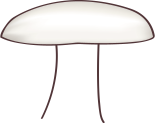
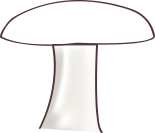
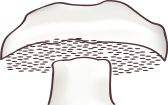
Pileus reaching approximately 5 cm in diameter in fully developed specimens, hemispherical in its early stage, becoming nearly flat at maturity. Pileal surface light-colored, whitish or more typically cream, with a somewhat rugose or fibrillose cuticle, completely glabrous and dry in appearance. Margin involute in young specimens, smooth and slightly undulate in mature specimens.
Hymenium composed of rather short white tubes that are decurrent on the stipe, though not markedly so. Pores concolorous when young, becoming somewhat creamier with age, angular or polygonal, and of irregular size.
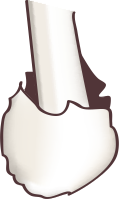
Stipe proportionate to the pileus, hard and tough. Attachment may be central or eccentric, more rarely lateral. Color is cream in the upper two-thirds, dark at the base, almost blackish. Solid, mostly curved, and attenuated or subradicate at the junction with the substrate.
Flesh tough and elastic, not very thick, whitish in color, more fibrous in the stipe. Odor and taste are indistinct.
Habitat:
This species fruits exclusively on the roots of certain grasses, thus appearing apparently on bare ground without surrounding trees. It grows gregariously, although we consider it a rare and uncommon species, found in spring and autumn on fallow land.
Observations:
This fungus is characterized by its small size, white or cream coloration, lack of scales, and above all by its habitat on grass roots; we consider these features make it nearly unmistakable. Other congeners with a lignicolous habitat may appear similar, but what is striking is that upon collection, it appears to be growing on bare ground with no trees nearby. These specimens were found in May in the Burgos locality of Gumiel de Izán, by the side of a path, on uncultivated land.