
Calocybe ionides
Taxonomy
Main synonym
Common names
Calocybe violeta, ziza zuri-morea.
Geographic references:
Interactive map with data from GBIF.


Morphological Features:
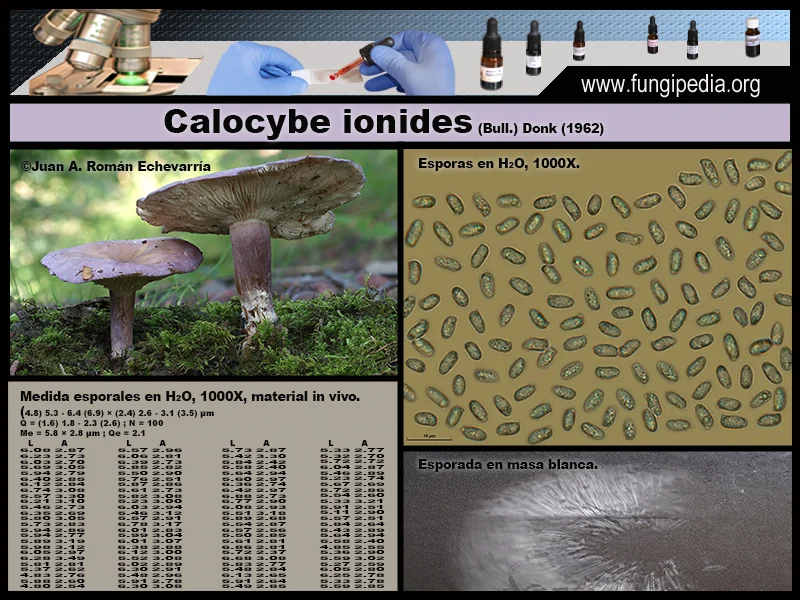
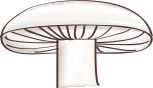
Pileus with a diameter ranging from 2 to 5 cm in mature specimens; initially convex and somewhat gibbous, with a raised center, expanding during development to become flat, or even slightly depressed in some specimens from our collection. It exhibits a striking coloration, ranging from dark violet to light lilac, generally quite uniform in young specimens, fading somewhat with age, occasionally developing creamy tinges when old but retaining the predominance of lilac hues. Cuticle dry and matte, slightly fibrillose or silky when young. Margin initially incurved, later extending, smooth, and fairly regular.
Lamellae fairly crowded, predominantly white in color, but tending to acquire yellowish or creamy tones with development; usually crenulate or even randomly fissured. Attachment to the stipe is irregular depending on the specimen: often adnate, sometimes slightly sinuate before terminating on the stipe with a slight decurrent tooth.
Stipe with a length proportional to the pileus diameter, cylindrical, solid in young specimens but tending to become hollow when old; color similar to that of the pileus or even slightly darker, fibrillose and finely longitudinally striate, with a white zone at the base of the stipe encompassing the portion not exposed to air.
Flesh firm and rather thick, white in color, sometimes with lilac tinges beneath the cuticle, invariable on cutting, with a pronounced farinaceous odor and an equally pleasant farinaceous taste.
Habitat:
This is a rare species, difficult to locate, for which we only know a couple of sites: one under beech trees (Fagus sylvatica), and another in a garden with firs. In fact, it is considered endangered in many regions, although, as often occurs with other taxa, it may be more widespread than currently documented. It is true that where it occurs, it generally fruits in groups rather than as isolated specimens. According to the literature, it is a cosmopolitan species, without preference for a specific habitat or soil type. Although it is not unreasonable to encounter it at other times of the year, it fruits preferentially in autumn.
Observations:
This species is macroscopically characterized by its beautiful lilac coloration on both the pileus and stipe, which contrasts with its white or slightly yellowish lamellae, as well as by its pronounced farinaceous taste and odor. Given its rarity and in accordance with species conservation criteria, it should be considered without culinary value; despite its acceptable taste, it must not be collected. Inexperienced collectors may confuse this species with Lepista nuda due to coloration, but the latter never possesses white lamellae. It does bear a considerable resemblance to the montane species Calocybe onychina, which also exhibits a farinaceous odor, but lacks this lilac coloration, being rather brownish with purplish tinges, and whose lamellae are a very bright yellow.

Microscopy of Calocybe ionides