Calocybe onychina
Taxonomy
Main synonym
Common names
Ziza zuri-more
Geographic references:
Interactive map with data from GBIF.




Morphological Features:
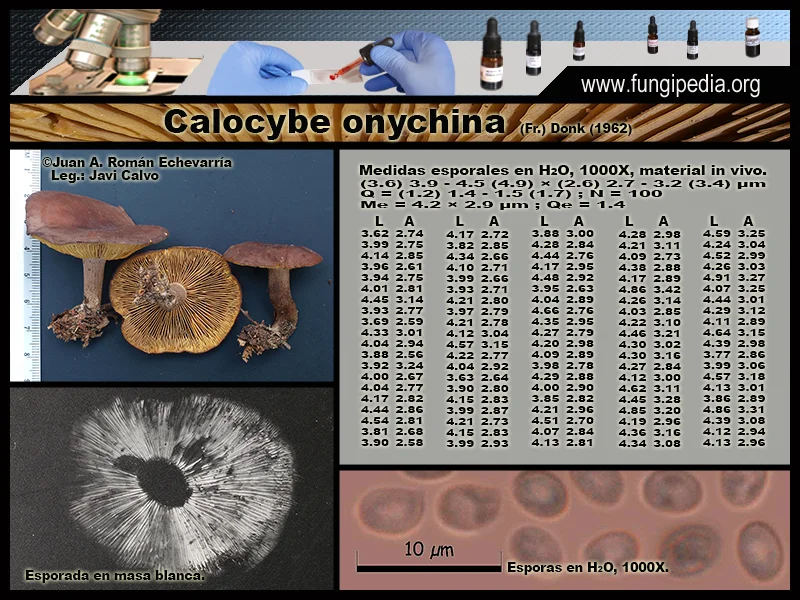
Pileus of medium size, with the diameter of collected specimens ranging from 3 to 8 cm, although it is documented that they can occasionally exceed 10 cm. Initially convex during early development, it becomes plano-convex and finally flattens considerably, with the center sometimes slightly raised forming a small, obtuse umbo; however, this feature is not evident in all specimens. The cuticle exhibits a striking purplish-brown color, slightly darker at the center; it is smooth and glabrous, though occasionally somewhat rugulose. The margin is involute when young, later becoming extended and thin, without evident striations. The overall appearance is quite fleshy.
Lamellae adnate and relatively crowded, with abundant lamellulae of varying lengths, somewhat irregular in their approach to the pileal margin. In younger specimens, they display a striking golden-yellow color that contrasts markedly with the pileus; over time they become less conspicuous but always retain a yellowish tint. The spore print is white.
Stipe well-proportioned to the pileus in size, occasionally somewhat elongated, cylindrical and solid, with a fibrous texture, straight or slightly curved at times, and with an attenuated base in some specimens. It is brownish in color with a covering of purplish fibrils, except perhaps at the base which is usually paler, with the presence of whitish mycelium. The overall coloration resembles that of the pileus and contrasts strongly with the lamellae.
Flesh quite fleshy and firm, particularly in the pileus, more fibrous in the stipe, whitish in color with a slight yellowish tinge. In our collection it has a faint odor, slightly farinaceous but nothing like its congener Calocybe gambosa; the taste is also somewhat farinaceous but not pronounced.
Habitat:
This is a species that should be classified as scarce or rare, although it is quite cosmopolitan, with recorded habitats in both deciduous and coniferous forests, almost always associated with high-altitude or mountainous areas. Where it fruits, it typically does so in small groups; isolated specimens are rarely encountered, and it is a predominantly autumnal species. The specimens used for this description were collected in November in the Burgos locality of Arauzo de Miel, at an altitude of 1060 m, in a mountain coniferous forest with Pinus sylvestris and Pinus pinaster present.
Observations:
We are dealing with a striking species characterized by the strong color contrast between the purplish-brown pileus and stipe versus the beautifully yellowish lamellae, as well as its slightly farinaceous odor and taste. For these reasons, it is a relatively easy species to identify, although other conspicuously colored Calocybe species exist, such as Calocybe ionides, which has a violet pileus and stipe but white lamellae in this case; Rugosomyces persicolor, with a pinkish pileus and also white lamellae; or perhaps the most similar, the rare Calocybe naucoria, which also has yellow lamellae but lacks the purplish tones of the pileus.
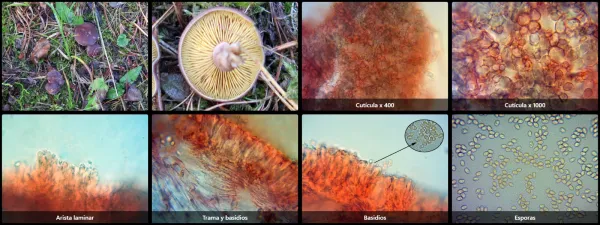
Microscopy of Calocybe onychina