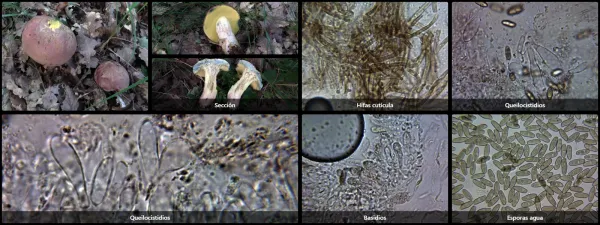
Butyriboletus appendiculatus
Taxonomy
Main synonym
Common names
Onddo hankazorrotz.
Geographic references:
Interactive map with data from GBIF.




Morphological Features:
Pileus of substantial size, reaching up to 20 cm in diameter, although typically found between 10 and 15 cm. Initially hemispherical, it becomes convex, and finally plano-convex. The surface is light to medium chestnut-brown, notably dry and finely tomentose when young. Margin slightly excurrent, but not excessively so.
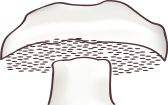
Tubes adnate, yellow when young, gradually turning olive-toned with age; they blue upon pressure.
Pores round and uniform, bright yellow, rather small, bluing upon touch.
Stipe central, thick or ventricose in young specimens, later cylindrical, tapering at the nearly radicate base. It is very robust and yellow, although the base is ochraceous.
Flesh firm and compact, additionally thick, yellow in color (sometimes brighter, at other times more diffuse), bluing upon cutting but with light blue tones. At the stipe base it may turn reddish when cut; this is where the flesh is hardest, exhibiting a cork-like texture. Its odor is unremarkable and its taste sweet and pleasant.
Habitat:
This mushroom fruits during summer months and also in autumn, provided temperatures remain mild. It is commonly found associated with broadleaf trees, particularly oaks.
Observations:
Once the lower half of the stipe is discarded, this mushroom constitutes a choice edible, but it has the drawback of becoming wormy easily, as is typical for most summer-fruiting species. Boletus fechtneri resembles it closely, but is lighter in tone and features a pink-tinged stipe. Caloboletus calopus possesses bitter flesh and reddish reticulation on the stipe.