
Boletus reticulatus
Taxonomy
Main synonym
Common names
Boleto reticulado, udako onddo zuri.
Geographic references:
Interactive map with data from GBIF.


Morphological Features:
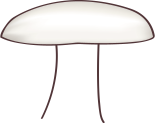
Pileus 10 to 15 cm in diameter, initially hemispherical becoming convex, and eventually plano-convex. The most common color is brown, although the shade varies according to specimen conditions, sometimes adopting grayish tones during dry periods. The cuticle is smooth and finely pubescent, particularly when young, and can be relatively easily separated from the flesh.
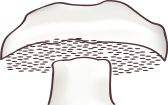
Tubes practically free from the stipe, long and slender, white in young specimens, later turning olive-yellow, unchanging.
Pores round, white in color, evolving to yellow, and eventually greenish. Unchanging to touch, perhaps becoming slightly soiled at points of injury.
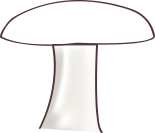
Stipe thick and short in its early stage, later cylindrical and elongated, lighter in color than the pileus, sometimes even white. It usually bears a visible reticulum, especially on the upper portion.
Flesh thick and firm when young, becoming softer with age, particularly in the pileus. White throughout, unchanging on exposure. Odor and taste pleasant.
Habitat:
A species that fruits exclusively under deciduous trees, appearing from late spring to early autumn. It is quite common.
Observations:
It is the typical summer Boletus of the edulis group, a choice edible, commonly attacked by insect larvae, which is normal given its fruiting period. It can be easily confused with Boletus edulis, which is more autumnal and has a cuticle that is only separable when very old. We collect specimens of this species every year that are fragile, with an elongated and entirely white stipe lacking any trace of reticulation; they appear distinct from the type species and warrant further study. Tylopilus felleus has bitter flesh, a more heavily reticulate stipe, and pores that turn pinkish with maturity.
