

Tylopilus felleus
Taxonomy
Main synonym
Common names
Camaleón rojo, chupasangre, onddo mingots, mataparent amarg.
Geographic references:
Interactive map with data from GBIF.




Morphological Features:
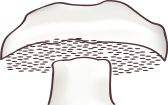
Pileus with a fleshy appearance and a diameter in adult specimens that can exceed 10 cm and even approach 15 cm. Initially hemispherical at emergence, it later becomes convex, a state maintained for much of its development, eventually becoming plano-convex, and rarely completely flattened. The surface is dry, initially somewhat velvety and later tomentose, with a color ranging across various ochre shades, from suede-like to nearly brown, sometimes very pale. The margin, highly regular when young, tends to become sinuate in older specimens.
Tubes rather elongate and sinuate, white in young specimens, turning pinkish upon maturation and brownish in age.
Pores small for the genus, initially rounded but soon becoming irregularly angular; white in young specimens, pinkish upon sporulation, and staining when touched.
Stipe with a solid appearance, thickened at emergence but soon becoming cylindrical and solid; background color is ochraceous with olivaceous tones or simply brown, traversed by a prominent and highly conspicuous reticulum that sometimes may cover practically the entire stipe.
Flesh thick, firm in young specimens and softer in adults; white, turning slightly pinkish with age. It has a pleasant fungal odor, but its taste is intensely bitter.
Habitat:
The few times we have encountered this species, it has been under conifers, although growth under broadleaf trees is also reported. It is a rare species that typically grows rather solitarily; we have never observed it in groups. Its preferred fruiting season is summer, though it may also appear during autumn; it is a fairly thermophilous species.
Observations:
An inedible species due to the bitterness of its flesh; upon cooking, this bitterness does not disappear but rather intensifies. Consequently, if mistakenly confused with edible Boletus species, a single specimen would be sufficient to spoil an entire dish. Fortunately, it is non-toxic. When young and with white pores, it is easily confused with Boletus reticulatus or Boletus edulis; the former may also more readily coincide in fruiting season. Curiously, the species described here possesses a much more pronounced stipe reticulum than reticulatus, despite the name suggesting otherwise.