Boletus edulis
Taxonomy
Main synonym
Common names
Hongo Blanco, calabaza, miguel, cep.
Geographic references:
Interactive map with data from GBIF.




Morphological Features:
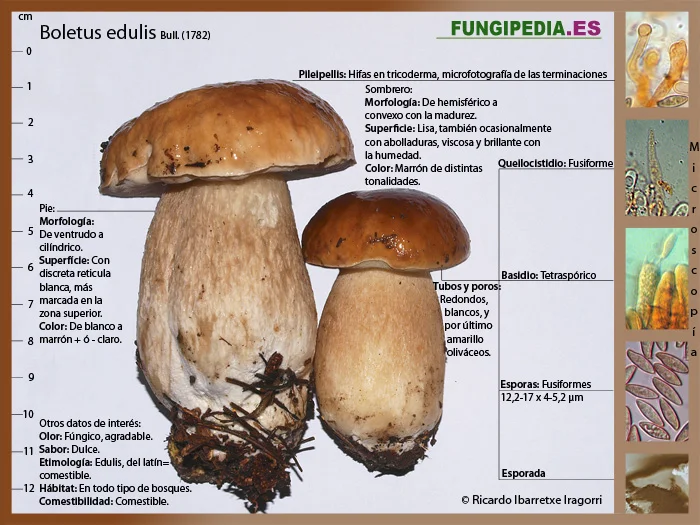
Pileus occasionally reaching large dimensions, up to 30 cm in diameter, highly variable in color with brown predominating, and a lighter margin. Very fleshy, slightly viscid during rainy weather, becoming dry afterwards. Shape ranges from hemispherical to convex, flattening with age.
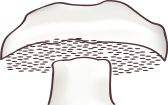
Tubes white when young, turning yellow with age and finally greenish; easily separable from the pileus and not reaching the stipe (free).
Pores concolorous, remaining unchanging both upon handling and bruising.
Stipe solid and firm, ventricose when young, later becoming more cylindrical; as fleshy or fleshier than the pileus itself, generally white in color, and sometimes, though not always, bearing a fine reticulation on the upper portion.
Flesh white and unchanging upon exposure to air; firm when young, becoming more spongy with age; possessing a pleasant fungal odor and a hazelnut-like flavor.
Habitat:
This is a species adapted to a multitude of habitats. We have had the pleasure of finding it in pine forests, oakwoods, beechwoods, spruce forests, and even heathlands.
Observations:
A choice edible, unfortunately pursued in an even obsessive manner by those who aim to collect euros from the ground rather than mushrooms. Recently, there has been a tendency to split different species from this taxon, such as Boletus venturii, personii, betulicola, etc., an initiative that is, at the very least, debatable. It can be confused with Boletus reticulatus, which has more spongy flesh and a separable cuticle, as well as with Tylopilus felleus, which has bitter flesh and pores that turn pink upon maturation.

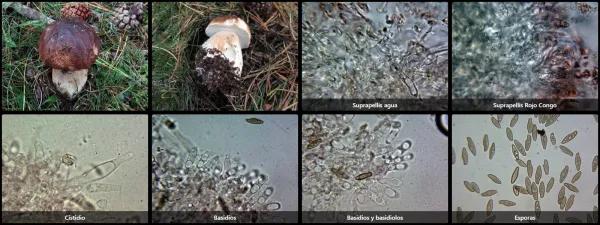
Microscopy of Boletus edulis