
Desarmillaria tabescens
Taxonomy
Main synonym
Common names
Armillaria sin anillo.
Geographic references:
Interactive map with data from GBIF.
Morphological Features:
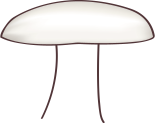
Pileus when fully developed measures approximately 5 cm in diameter, initially convex during early developmental stages, subsequently becoming quite flattened while retaining an obtuse umbo at the center. The surface is ochraceous to honey-colored, entirely overlaid with scales darker than the surrounding tissue, appressed in the central region and sparse toward the margin. The margin is regular or slightly undulate, devoid of any veil remnants, and smooth.
Lamellae adnate to slightly decurrent, pale in color ranging from whitish to cream, somewhat ventricose or arcuate, and not very crowded.
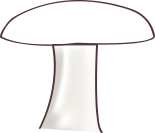
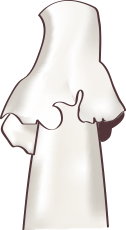
Stipe devoid of an annulus, cylindrical and elongated or proportionate to the pileus dimensions. It is paler than the pileal surface and smooth.
Flesh thick and firm, white in color, becoming more fibrous toward the stipe. Odor strong and unpleasant; taste congruent with the odor.
Habitat:
A rare and infrequently encountered species that fruits on the wood of various Quercus species; we have recorded it exclusively on oaks and holm oaks. It grows in caespitose groups during autumn, though specimens may also be found in summer.
Observations:
This species has historically been classified within Clitocybes due to the absence of the annulus typical of Armillaria; however, it is currently included in Armillaria, which we consider appropriate. Due to its coloration and growth habit, it is easily confused with Armillaria mellea, a more common species that possesses a conspicuous annulus. It may also be mistaken for other Armillarias, but all of them bear an annulus.