
Armillaria mellea
Taxonomy
Main synonym
Common names
Armilaria de color miel.
Geographic references:
Interactive map with data from GBIF.


Morphological Features:
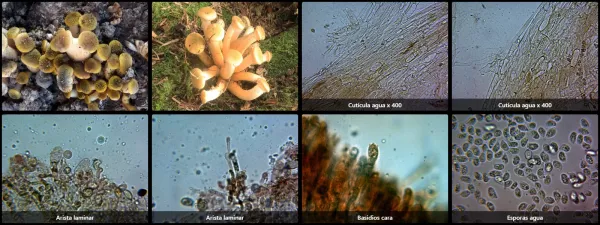
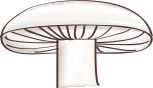
Pileus up to 15 cm in diameter when fully expanded, convex to flattened or undulate, slightly depressed with age and faintly umbonate, honey-colored though sometimes with yellowish tints, usually covered with small brownish scales that may occasionally wash away due to rain.
Lamellae somewhat decurrent, pale when young, later yellowish, staining brownish or reddish with age.
Stipe generally very long, curved, and sometimes fusiform, yellowish-ochre in color, turning brown with age. Bears a broad, membranous, persistent ring that is yellowish.
Flesh whitish and firm in the pileus, woody and fibrous in the stipe; mild-tasting in young specimens, bitter and unpleasant in mature ones, with a strong, not very pleasant odor.
Habitat:
Typically found from September through early winter. Grows caespitose in clusters of numerous individuals on stumps of various trees.
Observations:
There is no culinary tradition for this species in this region, although it is known to exist in other European countries; young pilei can be consumed after prior boiling. It is a parasitic species that causes irreparable damage to trees and eventually behaves as a saprotroph. It is easily confused with Armillaria ostoyae, which has a browner coloration and a white ring.