Amanita ponderosa
Taxonomy
Main synonym
Common names
Gurumelo.
Geographic references:
Interactive map with data from GBIF.




Morphological Features:
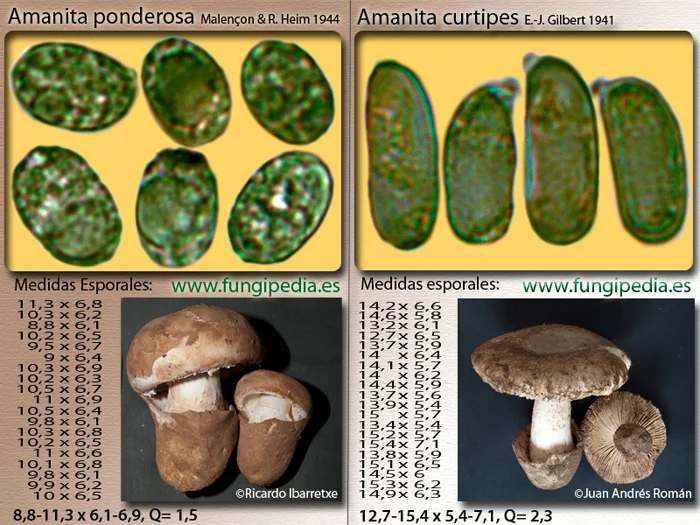
Pileus can exceed 10 cm in diameter, initially hemispherical, then convex, and finally flattened, quite fleshy. Its cuticle is smooth and dry, and its color varies according to its developmental stage; upon emerging from the volva it is whitish, then gradually shifts to ocre-pinkish tones, ultimately becoming reddish-brown. The margin is not striate.
Lamellae initially white, but it is one of those few Amanita species in which the lamellar color is not permanently white, tending instead to become cream-colored. They are somewhat crowded and free from the stipe.
Stipe thick, solid and full, ultimately robust. It is usually bulbous towards the base, and its color ranges from white to more pinkish tones, but always paler than the pileus. It bears a white but very ephemeral ring and a broad, persistent, membranous volva, white in color though it may not appear so, as it is invariably stained with soil.
Flesh white, slightly pinkish upon exposure to air, thick and firm, with a mild flavor and an earthy odor.
Habitat:
A species that appears during the winter months, from January to March, typically associated with holm oak and cork oak woodlands; endemic to southern Spain and northern Africa.
Observations:
An edible species, commonly consumed in some regions of southern Spain, where it is even sold in markets. A closely related species is Amanita curtipes, which does not attain the dimensions of the species described here. Confusion with the deadly poisonous Amanita verna is highly dangerous; it fruits in the same season and habitats, causing multiple poisonings in recent years. This species lacks the characteristic earthy odor of Amanita ponderosa and its flesh does not oxidize upon exposure to air.

Microscopy of Amanita ponderosa