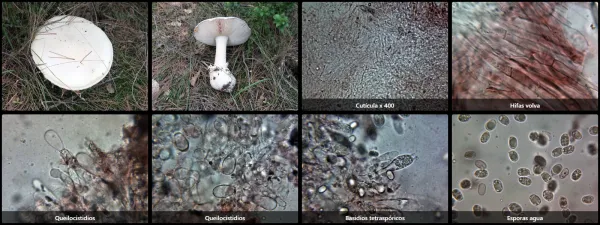
Amanita ovoidea
Taxonomy
Main synonym
Common names
Amanita ovoide, farinera, kukuma.
Geographic references:
Interactive map with data from GBIF.





Morphological Features:
Pileus of large dimensions, can exceed 20 cm in diameter, globose to spherical, later becoming convex; it rarely flattens out until the specimen is old. Its color is pure white, occasionally shiny, and its cuticle usually lacks volval remnants; however, it does retain veil remnants at the margin.
Lamellae crowded, equally white in color; free from the stipe, forming a sort of circle around it.
Stipe central, cylindrical and thick, white in color, bearing farinose scales of the same color. It possesses a fragile, farinose, concolorous, and fugacious ring, as well as a very robust, sac-like membranous volva, which may be white or yellowish-ochre.
Flesh white, very thick and compact, with a mild flavor and a barely perceptible odor.
Habitat:
Most frequently fruits under various broadleaf trees, particularly in holm oak woodlands, though it may also appear under conifers. It is an uncommon autumnal species.
Observations:
Despite being edible, we do not recommend its consumption for two reasons: it is not particularly suitable for culinary use, and it can be easily confused with toxic, even deadly poisonous, species. It must not be confused with the deadly poisonous Amanita virosa, which has a much smaller pileus and a membranous ring. The species it most closely resembles is Amanita proxima, characterized by a membranous ring, an absence of veil remnants at the pileal margin, and an orange volva.