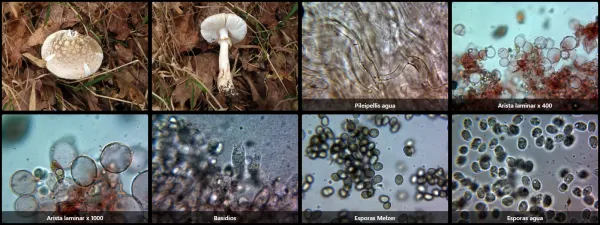

Amanita franchetii
Taxonomy
Main synonym
Common names
Lanperna ezkatahori.
Geographic references:
Interactive map with data from GBIF.





Morphological Features:
Pileus 5 to 10 cm in diameter, initially hemispherical, gradually expanding to convex, and finally flattened. The background color is grayish-brown, notably suffused with yellow, and covered with bright yellow warts that impart an even more yellowish hue. The margin is smooth, non-striate, and slightly incurved, especially when young.
Lamellae constitute the only non-yellowish part of the basidiocarp; they are white, rather crowded, free from the stipe, and occasionally slightly soiled.
Stipe central and cylindrical, elongated or thick, with a grayish-white background but covered in scales and notably suffused with yellow to the extent that it appears to be its dominant color. It bears a poorly defined volva and a yellowish-white ring.
Flesh thick and compact, white, remaining unchanging at points of injury. It has a rather unpleasant taste, despite its mild and faint odor.
Habitat:
Typically found beneath deciduous trees, but also occurs under certain conifers. A thermophilic species that appears in summer and continues into early autumn. It is not easy to locate due to its rarity.
Observations:
Collection is not recommended due to suspected toxicity. Its markedly more yellow coloration and unchanging flesh distinguish it from the choice edible Amanita rubescens, or galanperna galdacanesa, which has been consumed since time immemorial in the Galdakao area (Bizkaia), a species that exhibits evident reddish tones. A fo. lactella of Amanita franchetii exists, characterized by an entirely white pileus with yellow warts.