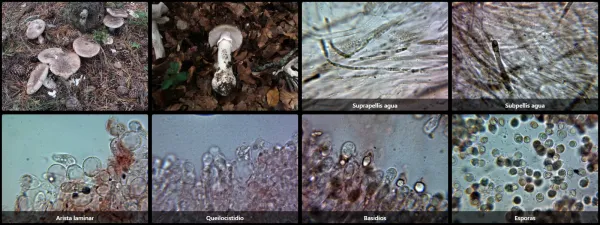
Amanita excelsa
Taxonomy
Main synonym
Common names
Oronja de pie grueso, lanperna ilun, cua de cavall grossa.
Geographic references:
Interactive map with data from GBIF.




Morphological Features:
Pileus up to 15 cm in diameter, emerging from the volva, hemispherical, then convex and finally flattened. When found under broadleaf trees it is distinctly gray, more ochre when found under conifers; its cuticle is covered with all the remnants of the volva, as little remains on the stipe; these remnants are whitish-gray. Its cuticle is separable and not striate.
Lamellae white, free from the stipe, broad and rounded near the pileal margin.
Stipe central and cylindrical, proportional to the pileus size, covered with brownish-gray scales, thickened at the base into a bulb-like structure. Its volva is barely perceptible on the napiform bulb. It is adorned with a broad and persistent ring, white and striate.
Flesh thick and compact, firm especially in the pileus, with a mild taste and a potato or radish odor.
Habitat:
It is commonly found in both coniferous and deciduous forests. Its fruiting season is summer and autumn. It is a common species that typically fruits in clusters.
Observations:
It is an edible species, though of very low culinary value. The most dangerous confusion for this species is with Amanita pantherina, a highly toxic species that lacks a napiform bulb and does not smell of potato; furthermore, it has a striate pileal margin. Amanita rubescens is also very similar, although they can be distinguished by the latter's marked tendency to reddening.