
Amanita curtipes
Taxonomy
Main synonym
Common names
Gurumelo chico.
Geographic references:
Interactive map with data from GBIF.




Morphological Features:
Pileus with a diameter ranging from 3 to 8 cm at most in fully developed specimens, initially hemispherical, becoming convex for much of its development, later expanding and sometimes even becoming slightly depressed in some individuals. The surface is white or pinkish-cream, though it may acquire ochraceous tones with age; smooth, it frequently bears remnants of the veil in the form of irregular, concolorous patches. Margin generally reflexed and fairly regular, smooth or faintly striate.
Lamellae free from the stipe, moderately crowded, white to slightly cream at maturity, occasionally exhibiting pinkish tints in some specimens; broad and generally lacking lamellulae.
Stipe typically short, though its length may vary depending on the substrate on which it fruits. White when young but becoming ochraceous with age; cylindrical and smooth or slightly fibrillose. The ring is very fugacious and may only be observed as adnate in young specimens; typically, no ring is apparent at the time of collection. The volva is membranous and open, not saccate, white in color though it may appear ochraceous due to adhering soil, sometimes terminating apically.
Flesh thick and firm, white, turning pinkish-flesh colored upon cutting, which darkens or becomes dingy over time. Odor mild and fungoid; taste pleasant.
Habitat:
Specimens were located in the pine forests of Aznalcazar (Seville) by our friend and collaborator Rafa Domínguez, to whom we are grateful for providing the material necessary for this description. This species fruits in both sandy pine forests and under holm oaks or cork oaks with an understory of Cistus. It is a fairly localized and poorly distributed species; however, where it occurs, it tends to be abundant. Fruiting occurs throughout autumn and may persist in some areas until spring, depending on climatic conditions.
Observations:
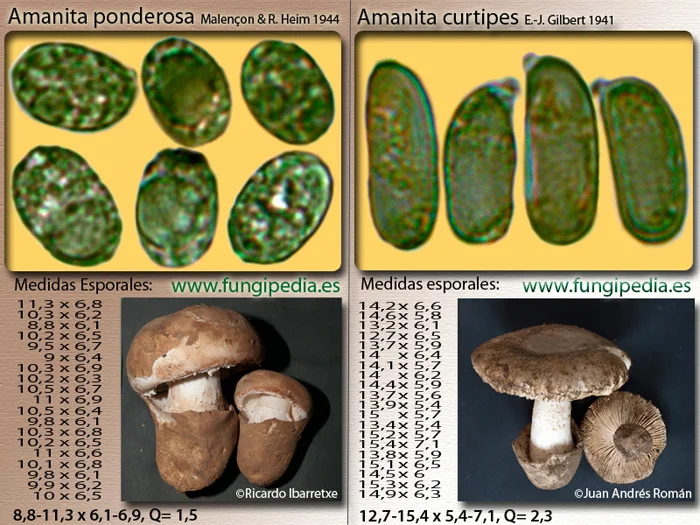
An edible species rarely collected for culinary purposes, it bears a striking resemblance to the Gurumelo or Amanita ponderosa, a larger species that is more highly regarded culinarily and possesses a more pronounced earthy odor. A more dangerous potential confusion exists with the deadly poisonous Amanita verna, which has unchanging white flesh, virtually no odor, and a broader, saccate volva. Amanita valens is considered by some authors to be an independent species, but it may well represent merely a variety with a more elongated stipe.

Microscopy of Amanita curtipes