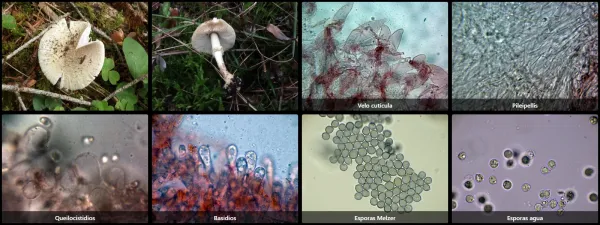
Amanita citrina
Taxonomy
Main synonym
Common names
Amanita citrina, oronja limón, lanperna limoi, reig bord groc.
Geographic references:
Interactive map with data from GBIF.




Morphological Features:
Pileus of medium size, its diameter ranges from 5 to 10 cm; it emerges from the ground globose, but soon becomes convex and finally flattens somewhat, becoming plane in its final stage. As its name indicates, it is lemon-yellow in color, at least in the type species, although it varies greatly in shade, occasionally becoming white. Its cuticle is glossy and viscid in wet weather, and is usually adorned with warts of a somewhat mealy consistency, whitish to ochraceous in color. This cuticle is also separable from the pileal flesh, and the margin is not striate.
Lamellae free from the stipe, crowded and with irregular spacing, fundamentally white in color, although they may exhibit yellowish tints or reflections.
Stipe central and cylindrical, solid when young and later hollow, generally longer than the pileal diameter and thus slender. Whitish to pale yellow in color, and provided at its upper portion with a concolorous, persistent, somewhat striate ring, and at its base with a whitish, circumscissile volva that tends to become ochraceous with age.
Flesh thick and firm, white in color, except beneath the cuticle where it takes on yellowish tints. Odor of potato or raphanoid; taste rather unpleasant.
Habitat:
It is an extremely abundant species that appears under virtually any type of tree. Except perhaps in winter, it can be found throughout the year.
Observations:
It is a mushroom that has long been considered deadly poisonous without actually being so, primarily due to its striking resemblance to the deadly Amanita phalloides, a species that, however, is greenish in color rather than yellow, possesses a fibrillose cuticle, an enveloping non-circumscissile volva, and lacks a potato odor; thus, there are many differences between the two. Another species with which it may be confused is Amanita gemmata, a toxic species that differs at first glance by its striate pileus.