
Amanita phalloides
Taxonomy
Main synonym
Common names
Oronja verde, oronja mortal, cicuta verde.
Geographic references:
Interactive map with data from GBIF.





Morphological Features:
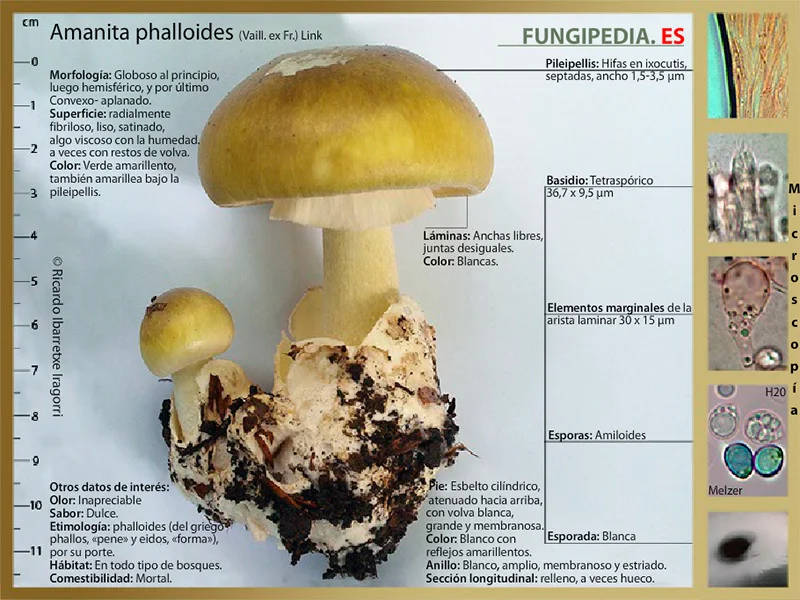
Pileus 5 to 15 cm, convex to flattened, predominantly green in color, sometimes very pale, almost whitish, and at other times darker, olive-green, with darker radial fibrils. Its cuticle often appears without remnants of the volva and is smooth, not striate.
Lamellae white and free, fairly crowded and broad.
Stipe central and cylindrical, quite long. It is normally white, but often exhibits areas with a yellowish-green tint, giving the stipe a greenish-bronze appearance. It bears a prominent white ring, weakly striate, and a sac-like volva, also white and membranous.
Flesh white, perhaps slightly greenish beneath the cuticle, not overly firm, with a mild and slightly sweet taste, and a pleasant odor when young, becoming unpleasant only when old.
Habitat:
Although it also occurs locally under conifers, we have consistently found it under various broadleaf trees, where it is sometimes abundant. It fruits during the autumn months, although it does not tolerate cold weather well.
Observations:
DEADLY POISONOUS. A single specimen can severely poison a person, and although medical treatment has advanced significantly and the mortality rate has decreased, the risk of fatality remains ever-present. It can be confused with the harmless Amanita citrina, and has even been mistaken for Russula virescens, which lacks both a ring and a volva.
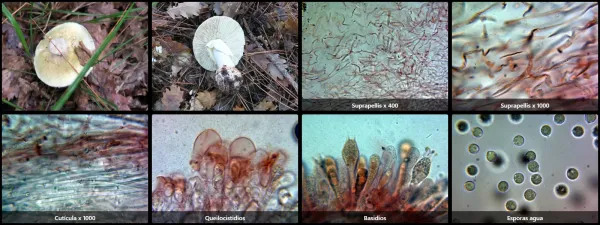
Microscopy of Amanita phalloides