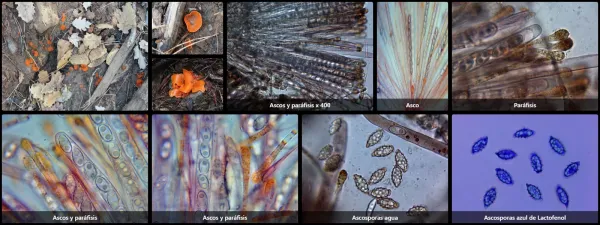

Aleuria aurantia
Taxonomy
Main synonym
Common names
Peziza anaranjada, cassoleta taronja, katilu laranja.
Geographic references:
Interactive map with data from GBIF.




Morphological Features:
Basidiocarp sessile, virtually stipeless, attached to the mycelium at a single point, goblet-shaped or cupulate; it sometimes flattens considerably, reaching nearly 10 cm in diameter under such conditions, although specimens around 5 cm are more commonly encountered. The external surface is pale orange and scurfy, and the cap margin tends to split and is irregularly undulate.
Hymenium formed by the inner surface of the basidiocarp, which is bright orange and highly conspicuous, occasionally acquiring reddish hues. Completely smooth, lacking folds.
Flesh thin, orange-colored, breaking with extreme ease; brittle. Nothing remarkable can be noted regarding odor and taste.
Habitat:
Fruits gregariously in sandy and loamy soils, even on forest tracks, always growing directly on the ground. Occurs equally in coniferous or deciduous forests, with autumn being its typical fruiting season.
Observations:
It is an edible mushroom but with scant flesh and mild flavor; it can be consumed either cooked or in salads, although it lacks culinary distinction. It may be confused with Sarcoscypha coccinea, a species that emerges with the spring thaw and features a scarlet red inner surface, as well as with Melastiza chateri, which bears hairs on the cap margin.