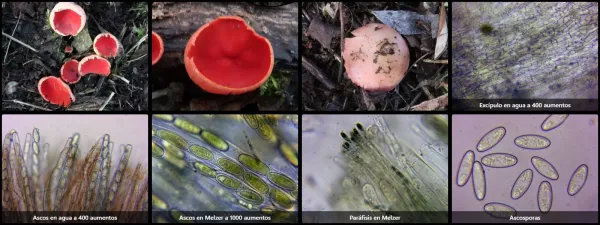

Sarcoscypha coccinea
Taxonomy
Main synonym
Common names
Peziza escarlata, txanogorritxu, cassoleta vermella.
Geographic references:
Interactive map with data from GBIF.

Morphological Features:
Carpophore cup-shaped, 2 to 5 cm in diameter, sometimes slightly flattened if the specimen is very mature. The color of the external surface is orange-red in its initial stage, quickly turning whitish, appearing granular to the eye and tomentose to the touch. The margin of the "cup" is usually sinuate and tends to yellow with age.
Hymenium lining the internal surface of the carpophore, bright red and highly conspicuous, smooth.
Stipe very short but distinguishable, barely 1 cm or slightly more in height, with a villous base.
Flesh soft and very thin, lacking any particularly notable odor or taste.
Habitat:
Fruiting on fallen branches of various trees, generally broad-leaved, although it is also known to occur on some conifers. The peculiar feature of this fungus is its fruiting season, as it emerges during winter and early spring, which is somewhat unusual.
Observations:
This beautiful winter fungus lacks culinary value, although it can be consumed without adverse effects. It typically grows in gregarious clusters, sometimes even partially covered by snow; despite the chromatic contrast, it is not easy to locate. Species of this genus cannot be differentiated without microscopic analysis; Sarcoscypha austriaca and Sarcoscypha jurana are practically identical species also recorded in the Iberian Peninsula.