
Agaricus urinascens
Taxonomy
Main synonym
Common names
Champiñón gigante, bola de nieve, elur bola.
Geographic references:
Interactive map with data from GBIF.
Morphological Features:
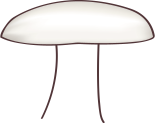
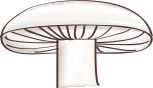
Pileus initially globose, gradually expanding to become first convex and finally plane. In the button stage its diameter can easily exceed 10 cm, while once expanded it may reach up to 40 cm. The cuticle is bright white and covered with concolorous floccose scales; with age these scales tend to become somewhat ochraceous, and the cuticle cracks noticeably in dry weather. When rubbed, the pileus stains a dirty yellow and emits a distinct odor reminiscent of bitter almonds, which is not perceptible in other parts of the fruitbody. Margin regular, bearing floccose remnants in young specimens that later disappear.
Lamellae adnate and quite crowded; while the fruitbody is in the button stage they remain whitish or pale gray, later turning pinkish, and finally very dark brown at the end of the life cycle. The lamellar edge is sterile, thus remaining whitish after spore maturity.
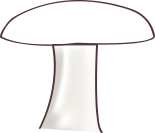
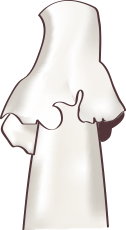
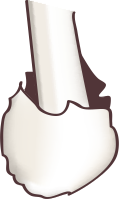
Stipe short and stout, cylindrical and solid, white in color. From the base up to the ring it is covered with floccose scales, while smooth above. It bears a persistent white ring, floccose and finely toothed on its upper margin.
Flesh thick and compact, white; upon cutting it stains yellow only slightly, but blushes somewhat at the stipe base. However, this species reacts to rubbing with dirty yellow tones that later become ochraceous. Its taste is sweet and pleasant; the odor is faintly anise-like at collection, becoming complex later but equally agreeable. Only in old, non-collectible specimens does it become stronger and somewhat unpleasant.
Habitat:
A species exclusive to mountain meadows or páramo grasslands; it has always been observed at elevations above 800 meters, where it fruits in rows or spectacular "fairy rings", rarely isolated. It typically produces a significant flush around May, in mid-spring, but also fruits during the autumn months. A frequent species within its habitat.
Observations:
Its exclusive habitat in mountain meadows or páramos, its certainly spectacular stature, and the size of its spores, which are larger than those of other Agaricus species, make it virtually unmistakable. As an edible mushroom, it is quite acceptable provided only young specimens in perfect condition are collected. Agaricus arvensis is similar and may share the habitat, but it is somewhat smaller, has a smooth cuticle, unequal lamellae, and smaller spores. The toxic species Agaricus xanthodermus is smaller, has an ink-like odor, and the stipe base stains bright yellow when rubbed.
