
Agaricus sylvicola
Taxonomy
Main synonym
Common names
Champiñón anisado, anis aspibeltz, bola de neu anisada.
Geographic references:
Interactive map with data from GBIF.



Morphological Features:
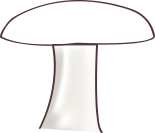
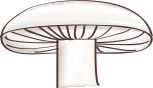
Pileus of good size; in adult specimens, the diameter may range from 7 to 12 (15) cm. Initially somewhat hemispherical, soon becoming convex and finally expanded. Cuticle smooth and glabrous, occasionally slightly fibrillose but entirely lacking scales of any kind. Pure white in color, turning dirty yellowish when rubbed; it is common to observe older specimens with a predominantly yellowish hue. Margin incurved in early stages, soon becoming straight and even acute, quite thin and regular.
Lamellae free and crowded, rather unequal in arrangement. Practically white in the early stages of development, evolving to pinkish-grey and finally dark brown upon maturity, as is typical for the genus. The sterile edge is usually lighter in color, even whitish.
Stipe cylindrical and elongated, frequently longer than the pileus diameter. Hollow from an early stage, rather bulbous at the base. White in color, particularly from the ring down to the base; above the ring it usually adopts a dirty pinkish tone. Like the pileus, it yellows upon handling, and bears a characteristic ring notable for its broad, skirt-like hanging form and farinose texture.
Flesh not overly thick but with a certain firmness. White when cut and practically unchanged, except perhaps for a slight pinkish tinge. Notably, although the exterior yellows markedly upon handling, the flesh does not yellow when cut. It possesses a distinct anise-like odor at collection that later turns to a faint scent of bitter almonds, accompanied by a pleasant taste.
Habitat:
As its name suggests, it is a species native to forests. It does not fruit in open fields or grasslands like other species of its genus, but rather occurs within forest interiors, both coniferous and mixed broadleaf stands. It typically appears mainly in late summer and throughout autumn, sometimes solitary or gregarious in small groups. It rarely forms fairy rings; however, it is a fairly frequent and widespread species.
Observations:
This is a species with good flavor and firm flesh; however, it is considered suspect by some authors. We have tasted it with pleasure and without any adverse effects, finding it highly palatable. It is characterized primarily by its forest habitat, the distinct anise-like odor emitted upon collection, the yellowing of its external surface, and the lack of yellowing in the flesh when cut. Do not confuse it with the toxic species Agaricus xanthodermus, which emits an unpleasant ink-like odor that intensifies upon cooking if mistakenly prepared, and exhibits strong yellowing of the flesh when cut at the stipe base.
