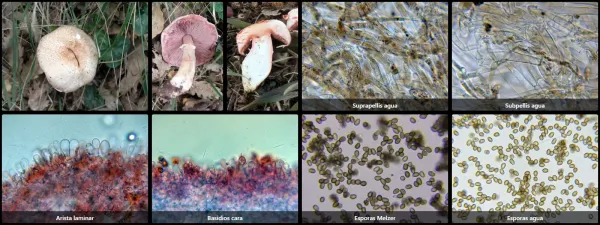
Agaricus sylvaticus
Taxonomy
Main synonym
Common names
Agárico de los bosques, basoetako aspibeltz.
Geographic references:
Interactive map with data from GBIF.




Morphological Features:
Pileus of medium size for the genus, its diameter usually ranges between approximately 5 and 10 cm, with a more or less globose shape in its initial phase, becoming convex later and finally expanded with a flattened center. Cuticle with a pale background color, but covered almost entirely by fibrillose scales of a much darker hue, dark ochre or brown, a color that predominates especially at the center; towards the margin, the scales are less abundant. Margin incurved in young individuals and later acute with a tendency to crack.
Lamellae free from the stipe, very crowded and straight, narrow, with a paler sterile edge; pink in young specimens, then brown, and finally dark brown to blackish-brown.
Stipe elongated and slender, with a graceful appearance, solid when young and later cavernous, frequently thickened at the base or even bulbous. It has a light color, practically white, smooth at the apex and pruinose below the ring; it bears a simple, descending, concolorous ring, often smeared with the color of the scales.
Flesh not too thick, white in color; upon cutting, or simply by scratching the stipe with a fingernail, it acquires a characteristic reddish tint, especially in young and fresh specimens, whereas in older ones it turns a dull color. It has a pleasant fungal odor and an equally pleasant taste.
Habitat:
This species forms mycorrhizae with conifers, fruiting predominantly in pine forests. It typically appears throughout autumn, forming clusters of numerous individuals, rarely isolated. In the Pinus sylvestris forests of northern Iberia, it is a frequent and relatively abundant species; however, it is rare in other areas.
Observations:
It is a fairly good edible; despite the unappetizing color it acquires upon cooking, its flavor is excellent. Furthermore, it is a species under investigation for its medicinal properties, utilized as an adjuvant in cancer patients, for instance, and cultivated for this purpose in certain regions. The most hazardous confusion is with small Lepiota species such as the deadly poisonous Lepiota castanea, which are smaller in stature and invariably possess white lamellae. Resemblance to other species of its genus and of the section sanguinolenti to which it belongs, such as Agaricus langei, poses no risk as they are equally edible.