Lepiota castanea
Taxonomy
Main synonym
Common names
Lepiota castaña, galanperna gaztainkolore.
Geographic references:
Interactive map with data from GBIF.




Morphological Features:
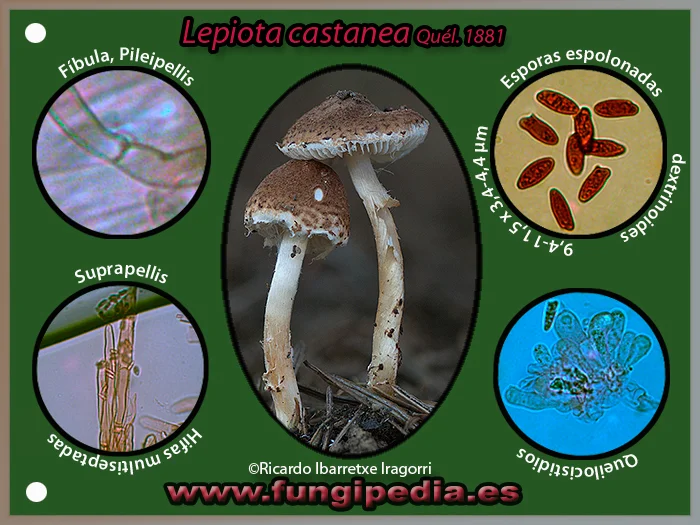
Pileus with a diameter in adult specimens ranging from 1.5 to 4 cm at most, bell-shaped in its early stages, becoming convex and finally flattening out, but retaining a broad, slightly pronounced umbo in the central area. Its cuticle is uniformly chestnut-brown when young, but quickly becomes scaly with irregular, rarely concentric scales of the same color, revealing a background with pinkish or reddish tints, while the central zone maintains a darker brownish-chestnut tone. Margin regular and thin, slightly to not at all undulate.
Lamellae free, white in color, fairly crowded, usually bearing some brownish stains; they turn reddish where handled but do not stain immediately upon touch.
Stipe elongated, at least twice the diameter of the pileus, cylindrical and fistulose from a young age. The upper third is white and completely smooth, followed by an annular zone lacking a distinct membranous ring, which is instead very fugacious; the lower two-thirds are covered with brownish scales on a chestnut background. These scales are labile and rub off easily, revealing a paler whitish background with pinkish or reddish tints.
Flesh soft, fragile, and thin, white in color except at the stipe base where it is pinkish-brown. It has a strong, pungent odor reminiscent of Lepiota cristata, though less pronounced, and its taste is also unpleasant.
Habitat:
Found in shaded areas with mixed woodland and directly in Pseudotsuga menziesii (Douglas fir) forests. According to the literature, it is a relatively frequent species in coniferous forests, although rare under broadleaf trees. It typically fruits in moderately sized groups, generally during autumn; our collection was made in November.
Observations:
A species among the small Lepiota mushrooms, placed within section Cristatae due to its echinulate spores, it is probably the most toxic species in its section. The presence of amatoxins has been demonstrated, albeit in lower concentrations than those found in species of section Ovisporae, making it potentially lethal at somewhat higher doses. Whether Lepiota ignicolor constitutes a distinct taxon or merely a variety of this species remains to be clarified; it is distinguished by its smaller size and fiery-red stipe base, though some authors consider them synonymous. Microscopic analysis is indispensable for the correct identification of many small Lepiota species.
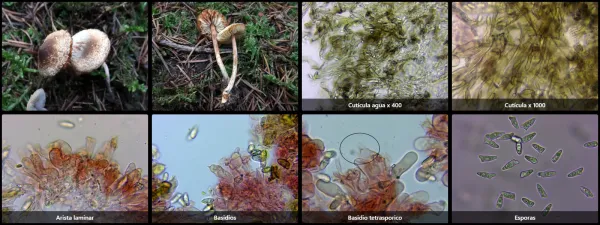
Microscopy of Lepiota castanea