
Agaricus litoralis
Taxonomy
Main synonym
Common names
Agarico del litoral.
Geographic references:
Interactive map with data from GBIF.


Morphological Features:
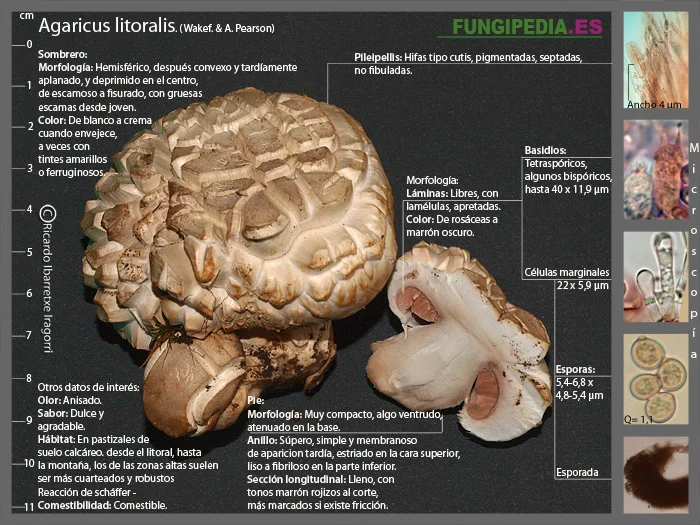
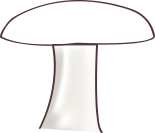
Pileus of substantial size, easily exceeding 10 cm in diameter; hemispherical at inception, generally becoming convex, and eventually flattening out in the final stage of development. White in color, though it adopts creamy-ochraceous tones with age and desiccation, occasionally yellowing slightly when rubbed. Cuticle covered with small scales, cracking rapidly from the central zone outward.
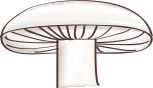
Lamellae adnate and crowded, pinkish when young, later turning brown as the spores mature, as is typical of all agarics.
Stipe short and compact, white in color, slightly attenuated at the base. Bears a superior ring with a skirt-like shape, matching the color of the rest of the stipe; smooth or weakly striate above, and floccose below. The stipe is smooth above the ring and floccose below it, and solid throughout.
Flesh firm and compact, white in color, slightly reddening upon cutting at the stipe base. Odor pleasantly fungal with a faint anise background; taste sweet.
Habitat:
A rare species in the north but abundant in other regions of the Iberian Peninsula. Appears in a first flush in spring and another in autumn, occurring in clearings of pine or holm oak forests, meadows, and grassy areas. Despite its specific epithet, it is not exclusive to coastal zones.
Observations:
A good edible, fleshy and with compact flesh. Due to the cracking of its cuticle, it may be confused with Agaricus arvensis, which has a smoother cuticle and a faint anise odor; however, it is most frequently confused with Agaricus bernardii, which is more strongly reddening, possesses an inferior ring, and emits a strong, unpleasant odor in mature specimens. The most dangerous confusion would be with Agaricus xanthodermus, which yellows both on the pileus and stipe and has a more disagreeable odor.

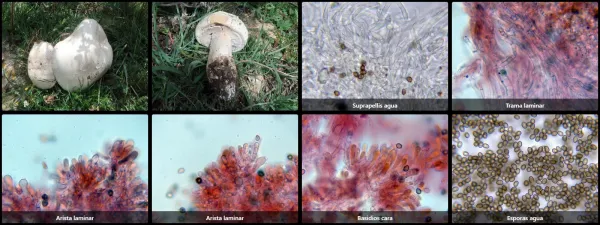
Microscopy of Agaricus litoralis