
Agaricus campestris
Taxonomy
Main synonym
Common names
Champiñón silvestre, champiñón de campa, barren-gorri, camperol.
Geographic references:
Interactive map with data from GBIF.


Morphological Features:
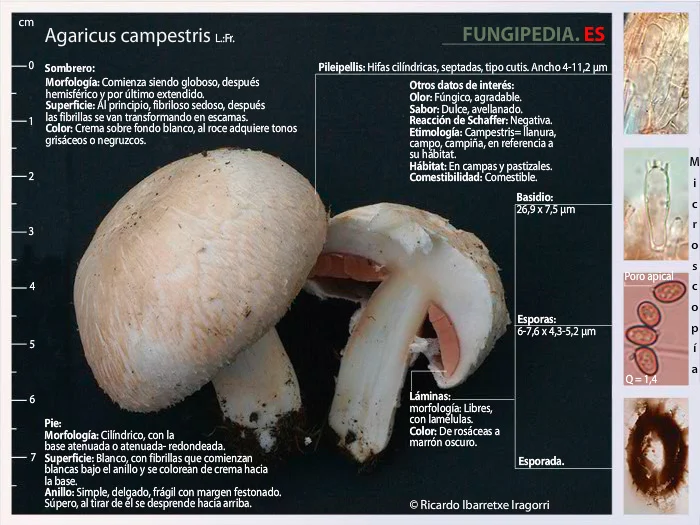
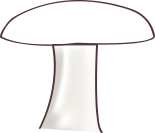
Pileus 5 to 10 cm in diameter, initially more or less globose, then convex, only flattening when the specimen is very old. Its primary color is white, although the scales covering the surface sometimes turn grayish, and occasionally acquire ochraceous tones, giving rise to certain varieties. The pileal margin usually bears fringes consisting of remnants of the veil.
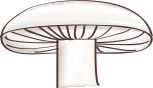
Lamellae free from the stipe, rather crowded, whitish at first, quickly turning pinkish, though darkening with maturity until adopting a nearly black brown color when old.
Stipe cylindrical and proportional to the pileus size, concolorous, solid, and lacking scales. A fundamental characteristic is that it detaches easily from the pileus. It bears a simple, ascending ring of the same color as the rest of the fruitbody.
Flesh thick and firm, white in color, turning slightly pinkish upon cutting, occasionally zonally, with a pleasant fungal odor and an equally pleasant sweet taste.
Habitat:
A species that fruits in both spring and autumn, typical of lowland grasslands and pastures fertilized by livestock, as it requires nitrogen-rich soils for growth. It is very common and, in some areas, highly abundant.
Observations:
An edible species commonly harvested for consumption. It is characterized by its lack of yellowing and absence of an anise odor, which clearly distinguishes it from Agaricus arvensis, which is occasionally found in the same habitats, also known as the snowball mushroom and equally edible. Do not confuse with Agaricus xanthodermus, a toxic species distinguished by the bright yellow color its flesh adopts when scratched with a fingernail, particularly on the pileus and at the stipe base.

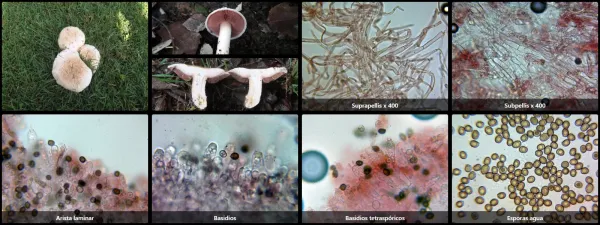
Microscopy of Agaricus campestris