
Agaricus arvensis
Taxonomy
Main synonym
Common names
Bola de nieve.
Geographic references:
Interactive map with data from GBIF.
Morphological Features:
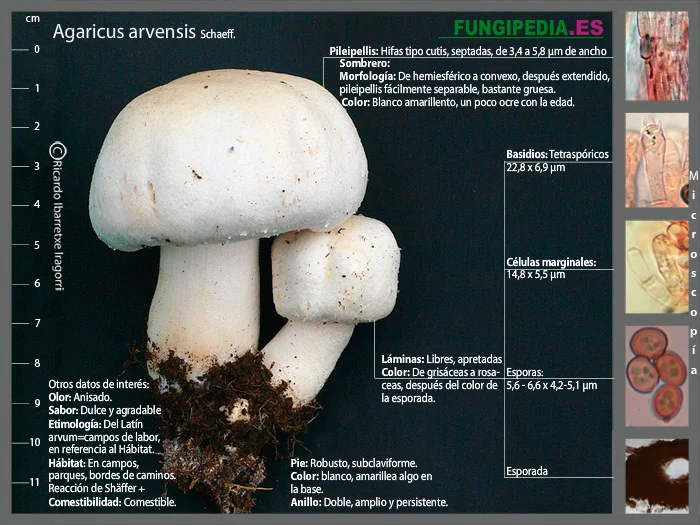
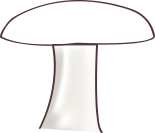
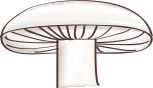
Pileus initially globose, then convex and finally expanded; in this state it can reach up to 25 cm in diameter. It is smooth or finely scaly, especially at the margin, white in color but yellowing both upon contact and with age, eventually adopting ochre tones. Cuticle separable.
Lamellae whitish in young specimens, turning pink thereafter, and finally chocolate-brown at maturity. They are free and quite dense, irregularly arranged, and rather broad.
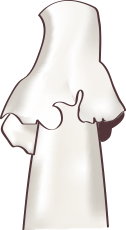
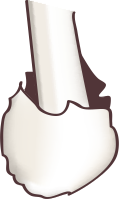
Stipe cylindrical, thick and solid, thickened towards the base, floccose below the ring and otherwise smooth. The ring is large, double, and toothed, quite persistent. It exhibits slight yellowing at the base.
Flesh thick and firm, white, but yellowing in the pileus when scratched with a fingernail. Its taste is mild and nutty, though it becomes somewhat unpleasant in older specimens; the odor is anise-like at the time of collection, but tends to fade thereafter, leaving a rather penetrating fungal smell.
Habitat:
It typically produces an initial flush in spring and reappears in autumn, normally associated with grasslands and meadows, though it has also been observed in herbaceous clearings within pine forests.
Observations:
This mushroom, common in the meadows of our region, constitutes a good edible species; it should only be collected when young, before the lamellae have turned brown. It is certainly similar to the also edible species Agaricus urinascens, which is native to mountain grasslands and high-altitude plains, is even larger in size, and has a distinctly cracked cuticle. It may be confused with Agaricus xanthodermus, which has an ink-like odor and whose stipe base turns bright yellow when scratched with a fingernail.

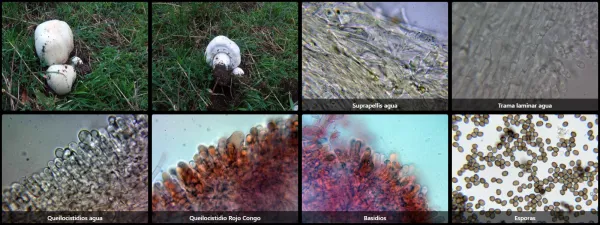
Microscopy of Agaricus arvensis