
Xylaria polymorpha
Taxonomy
Main synonym
Common names
Xilaria polimorfa, kimo formanitz.
Geographic references:
Interactive map with data from GBIF.
Morphological Features:
Carpophore composed of blackish stromata highly variable in size and shape; the most developed specimens can reach up to 10 cm in height and 3 cm in thickness at their widest point, although smaller individuals are more commonly encountered. Its name refers to its ability to assume multiple shapes, ranging from swollen or cylindrical forms to more elongated or slender ones, although it can sometimes be somewhat deformed with various protrusions. The external surface ranges from smooth to rough and does not crack.
Hymenium black, embedded within the external surface of the ascocarp; indeed, any roughness observed in this region is caused by the perithecia.
Stipe absent as such; it typically exhibits a narrowing toward the base, but merely as a simple continuation of the main body, with no distinct separation indicating a true stipe.
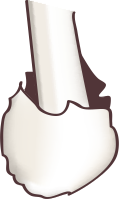
Flesh corky-textured and strikingly white, contrasting markedly with the black external surface. In cross-section, a characteristic spike-like internal pattern is visible.
Habitat:
It is a common species found within rotting beech stumps and generally on decaying wood of various broadleaf trees, although we must emphasize that its preferred habitat is beech, where we consistently locate it each year without difficulty. It very frequently grows in more or less numerous clusters, rarely isolated, and can be found practically year-round.
Observations:
This ascomycete is characterized by its robust stature compared to other species in its genus, its thick white flesh with a spike-like internal arrangement, and the absence of a true stipe. Xylaria longipes, which has smaller spores, does possess a true stipe, and its surface tends to crack over time; furthermore, its preferred habitat is maple wood. Other species in the genus are much smaller and even thread-like, making them less likely to be confused with the present species.