
Volvopluteus gloiocephalus
Taxonomy
Main synonym
Common names
Volvaria vistosa, kosko-ziza lingirdatsu.
Geographic references:
Interactive map with data from GBIF.


Morphological Features:
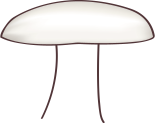
Pileus that at full development can exceed 10 cm in diameter. Its shape evolves throughout its life cycle, initially bell-shaped or resembling a time-trial cycling helmet, later flattening out. The surface color varies depending on hydration levels: silver-grey or olivaceous when hydrated, turning cream upon drying. In the aforementioned hydrated state, its cuticle is smooth and glossy; however, it becomes radially fibrillose when dry. Its thick, obtuse margin retracts upon drying, forming characteristic grooves absent in fresh specimens.
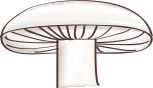
Lamellae free from the stipe, quite dense and therefore crowded, initially white, becoming stained pink by spore deposition.
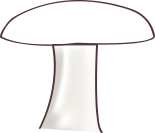
Stipe elongated, whitish in color, sometimes with a greyish tinge, narrower near the pileus and slightly thicker at the base. It bears a membranous, persistent white volva that is irregularly lobed.
Flesh not particularly thick and of soft consistency, despite the mushroom appearing fleshy. It is white in color with a sweet taste, although its radish-like odor is quite unpleasant.
Habitat:
The habitat of this species is somewhat diverse; it may appear in forests on nitrogen-rich soils, but it generally fruits on decomposed organic matter, sawdust, straw, or similar substrates. It is frequently found in urban gardens and dumps containing plant waste. It is relatively common, particularly during autumn, although it may also fruit at other times of the year.
Observations:
The genus Volvariella, formerly Volvaria, comprises species that share the presence of a more or less membranous and persistent volva on the stipe, along with a complete absence of an annulus. It differs from species of the subgenus Amanitopsis by its pink spore print, which stains the lamellae pink, whereas all Amanitopsis species possess a white spore print.