
Vibrissea truncorum
Taxonomy
Main synonym
Common names
Not available
Geographic references:
Interactive map with data from GBIF.
Morphological Features:
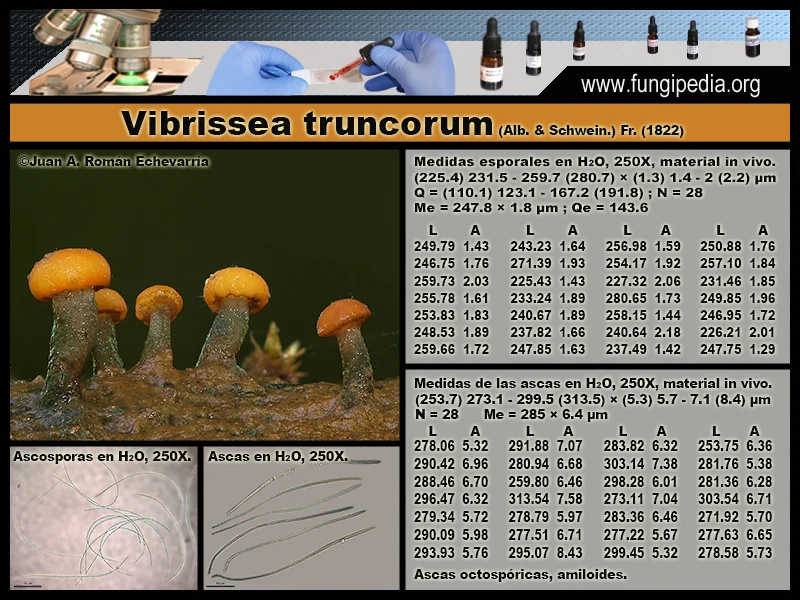
Carpophore of very small dimensions, reaching at most 15 mm in height, and up to 5 mm wide at its broadest point, which corresponds to the upper region. It is structured into two perfectly differentiated parts: an upper zone composed of a fertile head, and a conspicuous stipe. The overall appearance of the ascocarp resembles a small matchstick with a slightly viscous or gelatinous texture. There is a clear color difference between the two parts; the yellowish to orange hue of the head stands out, becoming more reddish upon specimen dehydration. Its cushion-shaped or hemispherical form sometimes closes over the stipe and remains open in other specimens, revealing a lower zone of paler yellow.
Hymenium immersed in the upper head, with the stipe being sterile. Yellowish in color, it produces large eight-spored asci (which may exceed 300 µm), within which the spores are arranged parallel to each other. The filiform spores may exceed 200 µm × 1.5 µm in width, are multiseptate, and fragment with unusual ease at the septa, making them very difficult to measure (see microscopic features).
Stipe of highly variable length, even among specimens from the same collection event; sometimes merely 3 or 4 mm long and at other times approaching 15 mm, with a diameter of only about 1.5 mm. It is cylindrical and initially whitish to grayish in background color, although it usually exhibits darker granulations, tending to darken or blacken from the base upwards.
Flesh tough with a gelatinous texture, whitish, completely tasteless, and lacking any distinctive odor worthy of mention.
Habitat:
This is a species characteristic of riverbeds, where it typically grows on decorticated and degraded branches of various broadleaf trees and riparian species. It has the peculiarity of always appearing on submerged or semi-submerged branches, requiring 100% humidity for fruiting. It is not an overly common species, but where it fruits, it typically does so in groups of numerous specimens or colonies; finding an isolated specimen is very rare. Its preferred season for appearance is spring, especially if rainy, or following mountain snowmelt from March onwards. While its occurrence in other seasons is possible, it is highly improbable given the extremely dry summers we experience.
Observations:
This is a small species with a gelatinous appearance, characterized macroscopically by its whitish-gray cylindrical stipe with dark granulations tending to darken, and its yellow or orange head, as well as by its aquatic or semi-aquatic habitat. In this same habitat, Mitrula paludosa also grows in spring; it is a larger species with a pure white stipe and ellipsoid spores bearing a single septum. Vibrissea flavovirens has a yellowish-green head and shorter spores, up to about 180 µm at most. Vibrissea decolorans, more closely associated with Rosaceae, has even longer spores, up to 280 µm. It may also be confused by appearance with species of other genera such as Cudonia, but its microscopic features are markedly different.
Microscopy of Vibrissea truncorum