
Verpa digitaliformis
Taxonomy
Main synonym
Common names
Verpa en forma de dedo, karraspina ditare.
Geographic references:
Interactive map with data from GBIF.


Morphological Features:
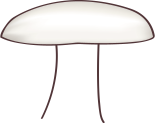
Pileus arranged at the apex of the carpophore as if it were a hood placed on top, very small in size, reaching at most 3 cm wide by about the same height. It is more or less glossy brown over the entire external surface, much paler, almost gray, on the internal side. It is pendant, i.e., it does not attach to the stipe at the base.
Hymenium occupying the external surface of the pileus; it is not alveolate as in *Morchella* spp., but merely slightly wrinkled or plicate.
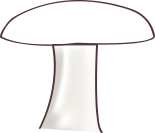
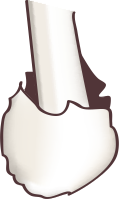
Stipe exceptionally long in proportion to the pileus, easily exceeding 10 cm, white or cream-colored, cylindrical, and often curved. It is usually adorned with small squamules and is hollow.
Flesh scanty, thin, and fragile, without a distinct odor and with a mild flavor.
Habitat:
This is an exclusively spring species that is difficult to locate, as it is not very common. It typically fruits on riparian trees such as elms, though not exclusively.
Observations:
We present here another spring edible species little known to enthusiasts; toxic when raw like all its congeners, however, it is poorly fleshy and does not remotely reach the level of excellence of *Morchella* spp. It may be confused with *Verpa bohemica*, which features longitudinal ridges on the pileus.